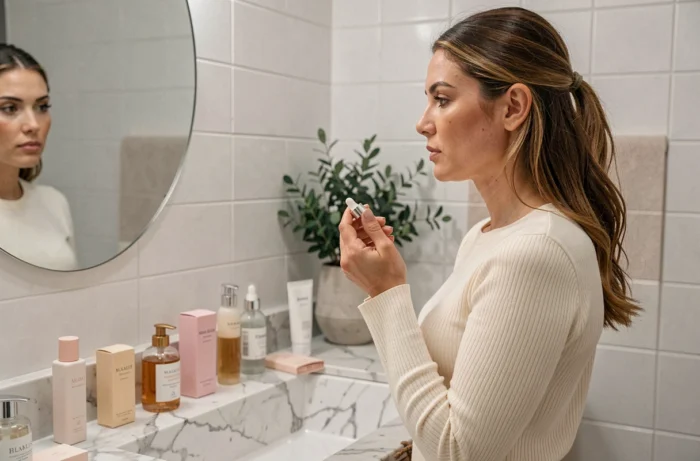
The beauty, health, and wellness categories are gradually merging into a single spending category. Consumers no longer think in silos: a facial serum, a dietary supplement, and a facial massage device end up in the same basket, evaluated according to the same criteria of effectiveness and value for money. This convergence is reshaping beauty shopping habits and complicating the construction of a coherent routine without an extensible budget.
Beauty routine and health budget: why the boundaries are fading
For a long time, purchasing a facial treatment was associated with the cosmetics aisle, while a dietary supplement belonged to the parapharmacy section. This separation hardly exists in the minds of shoppers anymore. Brands themselves blur the lines by offering ranges that combine a topical product (cream, serum) and an ingestible product (capsule, powder) sold together.
The concrete result: the beauty budget now includes expenses that were once classified under wellness or health. A consumer who hesitates between an anti-aging treatment and a home LED device compares two product categories that would never have coexisted in the same decision-making process five years ago.
To navigate this expanded offering, specialized platforms allow filtering products by actual use rather than by marketing category. On the shopping space of Pop Your Beauty, there is a selection that reflects this cross-cutting logic, mixing skincare, makeup, and accessories without artificial barriers.
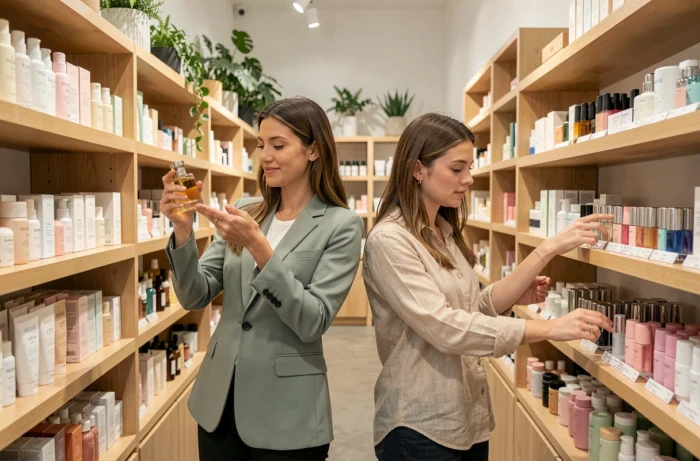
Omnichannel beauty shopping journey: from social media to delivered product
The discovery of a product rarely goes through a single channel. A tutorial on social media grabs attention, then checking the composition or reviews is done on a search engine or a dedicated app. The final purchase can take place in-store, on a distributor’s website, or directly via a marketplace.
Tinuiti describes this continuity between social media, search engines, apps, distributor sites, and physical stores in its analysis published in September 2026. This fragmented journey has a direct consequence on shopping habits: the displayed price is no longer the only criterion; proof of effectiveness weighs equally in the decision.
Brands that document their results (unedited before/after photos, transparent testing protocols) capture attention that simple marketing descriptions no longer retain. For the consumer, this means that multiple sources need to be cross-referenced before purchasing, which lengthens the decision time but reduces disappointments.
What this journey changes for building your routine
When building a skincare or makeup routine, the temptation is to accumulate references spotted along the way through recommendations. The omnichannel journey amplifies this phenomenon: each point of contact suggests a new product. An effective routine is limited to four or five complementary products rather than a dozen redundant references.
Before adding yet another serum to your selection, checking if it overlaps with an existing product helps avoid waste and undesirable interactions between active ingredients.
At-home beauty treatments and devices: replicating the salon without the price
In light of the cost of salon services, part of beauty shopping is shifting towards at-home devices. LED devices, microcurrent tools, facial drainage accessories: the offering has significantly expanded, with considerable price and quality variations.
The economic reasoning appears simple. A one-time purchased LED device replaces several salon sessions. In practice, field returns diverge on this point: the effectiveness of a home device largely depends on the regularity of use and the power of the device. A consumer model does not deliver the same intensity as a professional device.
Several criteria help distinguish a useful purchase from a gadget:
- The light power or current intensity must be clearly indicated by the manufacturer, with a reference to specific wavelengths for LEDs
- A product that promises results without mentioning a usage protocol (frequency, duration of sessions) lacks transparency
- Drainage or facial massage accessories do not require complex technology, but their effectiveness relies more on the technique of manipulation than on the price of the item

Cosmetic regulation and microplastics: a selection criterion in 2026
The composition of beauty products is becoming a full-fledged purchasing filter, driven by regulatory evolution. France announced at the beginning of 2026 a ban on microplastics in cosmetics, which could herald broader regulations at the European level.
European rules on microplastics impose different timelines depending on product categories. This means that not all facial or makeup treatments are affected at the same pace. Checking a product’s INCI list remains the most reliable gesture to spot the presence of synthetic polymers.
For the consumer, this evolution has a concrete effect on beauty shopping:
- Some formulations will disappear or be reformulated in the coming months, which may alter the texture or perceived effectiveness of familiar products
- Brands that have anticipated these restrictions already display formulas without microplastics, often identified by a pictogram or specific mention
- A more expensive product but compliant with future standards avoids the need to change references when the regulation comes into effect
Reading a cosmetic label: beyond clean beauty marketing
The mention “clean” or “natural” on a packaging does not guarantee the absence of microplastics or compliance with new rules. Only the INCI list, mandatory on all cosmetic products sold in Europe, allows for factual verification. Terms ending in “-one,” “-siloxane,” or containing “acrylate” signal the probable presence of synthetic polymers.
Building an effective and economical beauty routine in 2026 involves this sorting work. The available data do not allow concluding that formulations without microplastics are systematically less effective, but they sometimes require adjusting expectations regarding the texture or longevity of the product. This compromise, rarely mentioned in product sheets, deserves to be anticipated before purchase.