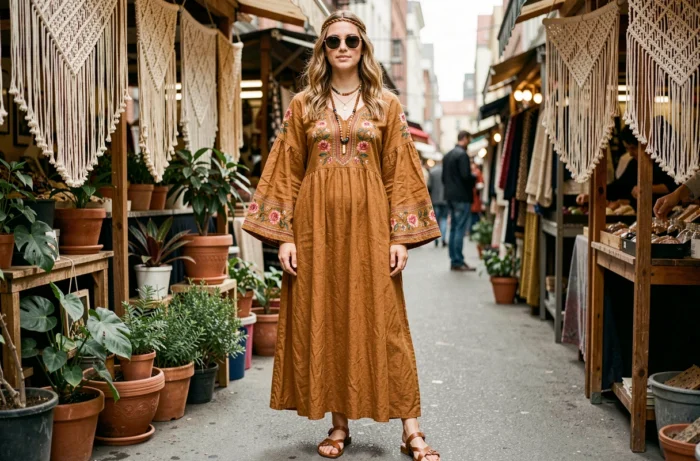
The spring-summer 2026 fashion shows have multiplied references to the 70s: flared pants, oversized floral prints, crochet vests. Meanwhile, the French second-hand market grew in volume and value in 2025, according to the report published by Refashion in September 2026. These two dynamics intersect: adopting the hippie style in 2026 no longer relies solely on new items, and the supply chains weigh as much as the choice of pieces.
Second-hand and 70s hippie style: a game-changing circuit
Searching for a fringed suede jacket or a long printed cotton dress in a thrift store is not a nostalgic gesture. Today, it is the most direct way to find pieces whose cuts, materials, and patterns genuinely reflect the spirit of the seventies, without resorting to sometimes approximate reissues.
Refashion’s data for 2025 shows that thrift stores and brand corners are driving the growth of second-hand in France, with a significantly sharper increase than that of sales between individuals or social and solidarity economy circuits. Le Figaro, in an article from September 30, 2026, reiterates this comparison. For those looking to create an authentic bohemian wardrobe, these specialized thrift stores offer a selection already curated by sellers who understand vintage cuts.
Not all resale circuits are equal. Oxfam France, in a report published on September 10, 2026, reminds us that resale models differ in their social and environmental effects. Buying a bell-bottom pant at a local consignment shop does not have the same impact as a purchase on an international platform.
To delve deeper into the trend and its fashion codes, the tips offered by Magmoiselle detail the pieces to prioritize and the style mistakes to avoid.
Materials and textiles to target for a credible hippie look
The most common trap when adopting the hippie chic trend is to focus on patterns (paisley, tie-dye, flowers) while neglecting the textile. A polyester blouse printed with flowers looks like a costume. The same cut in washed cotton or crinkled linen tells a different story.
Natural fibers as the foundation of the wardrobe
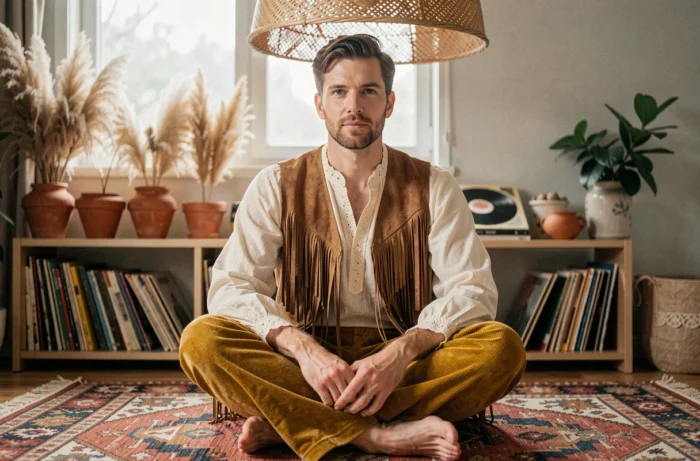
Cotton, linen, and hemp formed the basis of the original hippie wardrobe, rejecting synthetic materials associated with industrial production. In 2026, these fibers remain the best choice for achieving the fluid drape and slightly textured feel that characterize the style. Leather (jackets, belts, sandals) completes the ensemble, provided that soft, patinated leather is favored over rigid, shiny leather.
Handmade crochet and cotton lace are two strong markers of the seventies wardrobe. A crochet vest worn over a solid dress transforms a basic outfit into a bohemian silhouette without overdoing it. These pieces are easily found second-hand, often at prices well below those of new versions offered by current brands.
Materials to avoid
- Synthetic printed satin, which creates a costume effect rather than a vintage one, regardless of the chosen pattern.
- Very fine and stretchy velvet (stretch velvet type), too fitted to respect the loose cuts of the 70s hippie style.
- Plasticized or coated fabrics, even in “eco” versions, which contradict the natural and raw spirit of the movement.
Building a hippie outfit in 2026 without veering into costume
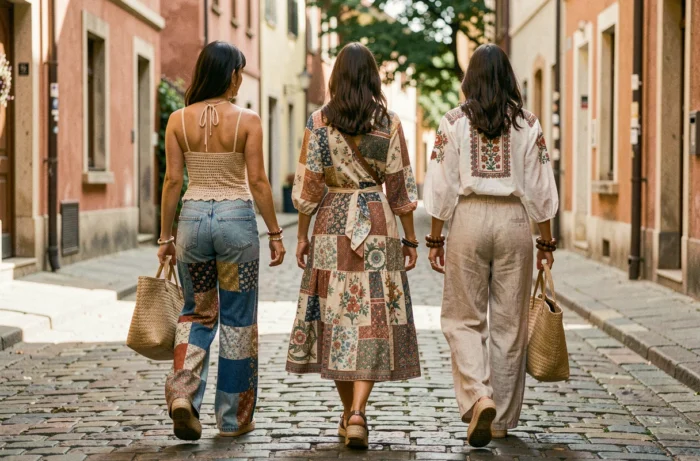
The challenge of this fashion trend lies not in the choice of individual pieces but in their assembly. Wearing a long floral dress, a fringed vest, a headband, and braided leather sandals simultaneously creates a reconstructed Woodstock effect. Limiting hippie markers to two or three per outfit is enough to anchor the style without caricaturing it.
A concrete example: a pair of raw denim flared pants (the cut alone evokes the seventies) paired with a simple top and a braided leather belt. Three elements, only one truly representative of the 70s (the pant cut), and the result works for everyday wear.
Accessories that make the difference
Accessories play a decisive role in balancing a bohemian-inspired outfit. Two categories stand out:
- Round or oversized tinted sunglasses, which are enough to steer an entire outfit towards the seventies vibe.
- Worn-in metal, turquoise, or wooden jewelry, worn in moderate accumulation (two or three bracelets, not fifteen).
- Soft leather or raffia bags, with the messenger bag format being the most coherent with the chic hippie silhouette.
On the other hand, wide-brimmed hats and headbands are the most difficult pieces to wear without veering into costume. They work better in a festival context than in urban attire.
Textile regulation in Europe: what changes for fashion in 2026
The European framework has evolved this year with the implementation of the ban on the destruction of unsold textiles. This measure, which concerns major brands and distributors, modifies the flow of unsold stock and could further feed the second-hand and clearance circuits in the coming months.
For consumers looking for hippie-style pieces, this evolution has a direct consequence: declassified or unsold stock from seventies-inspired collections could more easily find their way into resale circuits or clearance sales, rather than being destroyed. Brands that have surfed the bohemian wave in recent seasons will have volumes to clear in other ways.
This regulation does not apply to small creators or artisans, who generally produce in limited quantities. To find unique pieces in crochet, macramé, or handcrafted leather, creator markets and independent shops remain the most reliable circuit, unrelated to these new legal obligations.
The hippie style of the 70s, as practiced in 2026, relies less on the accumulation of folkloric pieces than on a refined selection of natural materials and precise cuts. The second-hand market offers the richest playground for this search, provided one chooses their circuit with as much care as their clothing.