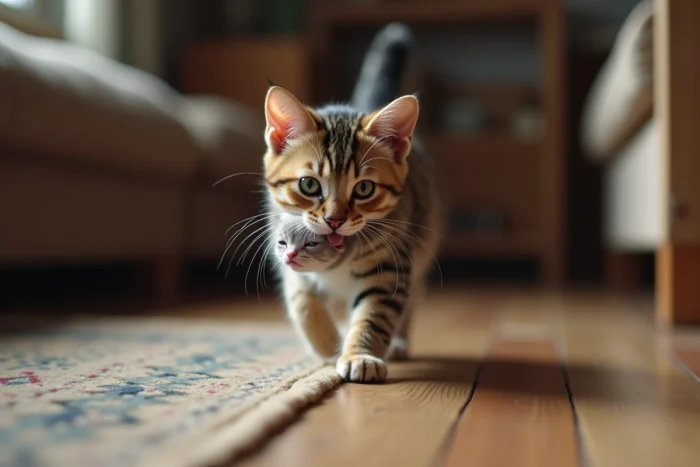
After giving birth, a cat can grab her newborns by the scruff of their neck and transport them to a location completely different from the initial nest. This behavior of moving the kittens is far from random; it responds to precise mechanisms inherited from wild felids. The mother constantly assesses her environment and makes decisions aimed at the survival of her litter.
Maternal Stress and Disturbance Threshold in Cats
The movement of kittens is not always a simple protective reflex. It often serves as a direct indicator of maternal stress. A cat that perceives her environment as unstable or threatening triggers this behavior much more frequently than a mother settled in a calm setting.
The threshold of disturbance varies from one cat to another. Some tolerate moderate comings and goings around the nest without reacting. Others relocate their litter as soon as a door slams or a visitor approaches too closely.
Several factors lower this tolerance threshold and prompt the mother to act:
- Repeated human handling of the kittens during the first few days, which leaves foreign scents on the little ones and triggers an alert in the mother
- The presence of other animals in the household (dogs, other cats), perceived as potential predators even if they are familiar
- A high or unpredictable noise level (construction, music, vacuum cleaner), which prevents the cat from resting between feedings
Understanding why my cat moves her kittens involves this behavioral reading: the mother does not move them on a whim, but because her assessment of danger has exceeded a critical threshold.
A cat can actually move her kittens several times in a row if each new location also proves unsatisfactory. This repetitive behavior reflects increasing distress, not indecision.
Microclimate Logic in Choosing the New Nest
Most articles on the subject mention the search for a “safe place” without going further. The reality is more nuanced. The cat selects a specific microclimate for her litter by crossing several physical parameters.
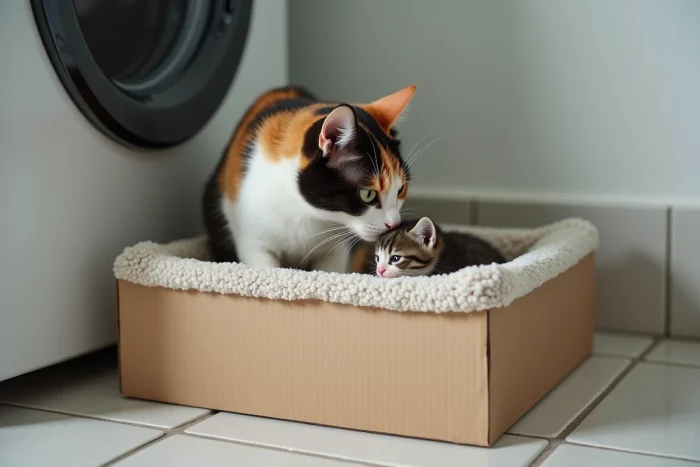
Temperature plays a crucial role. Newborn kittens do not regulate their body temperature autonomously. A mother who feels her little ones cooling down will move them to a warmer area, sometimes a closed closet, a space under a piece of furniture, or behind an appliance that emits heat.
Light and Air Circulation
Cats prefer dark and confined areas. A nest exposed to direct light or located in a ventilated hallway will be abandoned in favor of a darker corner. This behavior replicates the logic of wild felids, which nest in cavities or burrows to limit detection by predators.
The moisture of the substrate also comes into play. A blanket wet from a feeding accident or a leak is enough to trigger a move. The mother seeks a dry and stable surface.
Concealment Strategy and Choice of Unexpected Locations
A behavior that baffles many owners: the cat that places her kittens in an apparently absurd location (bathtub, open drawer, inside a moving box, behind the washing machine). These choices are not errors in judgment.
The mother applies a concealment strategy inherited from her wild ancestors. An unpredictable location for a human is also so for a potential predator. The main criterion is not visible comfort, but the absence of passage and difficulty of access.
This logic also explains why some cats move their little ones to high places. Felids associate height with better visual control of the environment and reduced risks of ground intrusion.
The Trap of Human Intervention
Consistently putting the kittens back in the initial nest after each move worsens the situation. The cat interprets this intervention as an additional threat, which strengthens her need to find a place that no one else knows.
The best approach is to observe the location chosen by the mother and discreetly enhance it: add a dry blanket, reduce ambient noise, limit traffic. If the location poses a real danger (risk of falling, proximity to a hot appliance), the move to a safe place should be done in one go, transporting the mother and the kittens together.
Nest Hygiene and Kitten Development
As the kittens grow, the nest becomes soiled. Residues of placenta in the first days, then the feces of the little ones who begin to feed differently, alter the smell of the nest. A strong concentration of odors attracts predators in the wild, and this instinct persists in domestic cats.
The movement then becomes a measure of hygiene as much as safety. The mother does not “clean” the nest beyond a certain level of soiling: she prefers to change it.
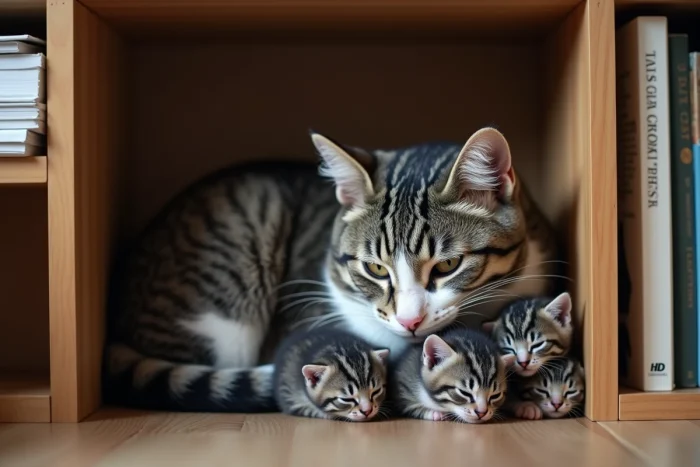
This behavior is more observed between the second and fourth week of the kittens’ life, when their growing size makes the initial nest too cramped. The cat also anticipates her litter’s need for space by choosing a larger location for the motor exploration phase.
The movement of kittens by a cat is never a trivial gesture. Each relocation reflects a precise assessment of the environment, thermal comfort, perceived threat level, or the sanitary condition of the nest. Observing without intervening remains, in the vast majority of cases, the most appropriate response to support this maternal behavior.