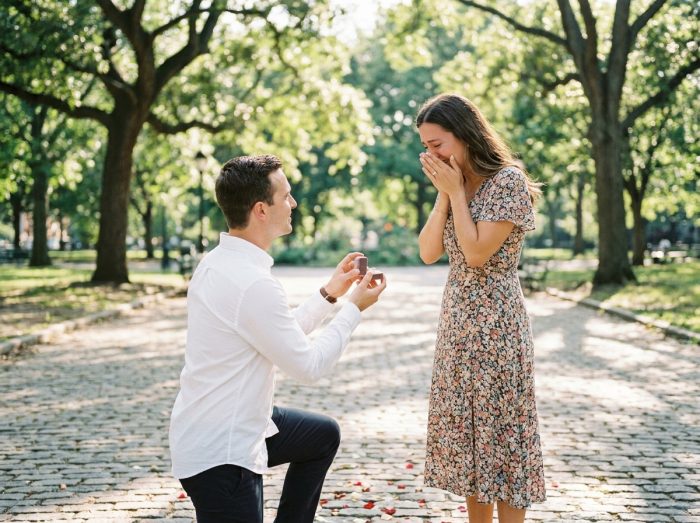
Giving an engagement ring during a marriage proposal is not just a simple accessory. This gesture alters the dynamics of the moment, the emotional weight of the occasion, and the way the couple builds their memory of commitment. With the rise of temporary rings, co-designing the jewelry, and the choice of ethical stones, the engagement ring today redefines what it truly means to ask someone to marry you.
Temporary ring or permanent ring: two very different proposals
A recent practice is disrupting the classic ritual. According to The New York Times, the trend of “placeholder” rings (inexpensive temporary rings used on the day of the proposal) has been growing significantly since the pandemic, especially among those under 35. The principle: to offer a symbolic ring to preserve the surprise, then design the permanent ring together after the “yes.”
This choice transforms the marriage proposal into two distinct phases. The first is purely emotional, focused on the question and the answer. The second becomes a shared project, where the couple visits jewelers, discusses budgets, selects a stone and a metal.
Signature models from major Houses often play a reference role in this stage. The Trinity Ring by Cartier, for example, remains a stylistic benchmark for many couples looking for a design that is both recognizable and timeless, before deciding on a more personal piece or opting for vintage.
| Approach | Effect on the proposal | Role of the jewelry |
|---|---|---|
| Permanent ring given on the big day | Total surprise, strong immediate emotional charge | The ring concentrates all the symbolism |
| Temporary ring then co-design | Surprise preserved, then shared project | The ring initiates the gesture, the final ring extends the commitment |
| Ring chosen together before the proposal | No surprise regarding the jewelry, staging of the moment | The jewelry is validated, the emotion rests on the location and the moment |
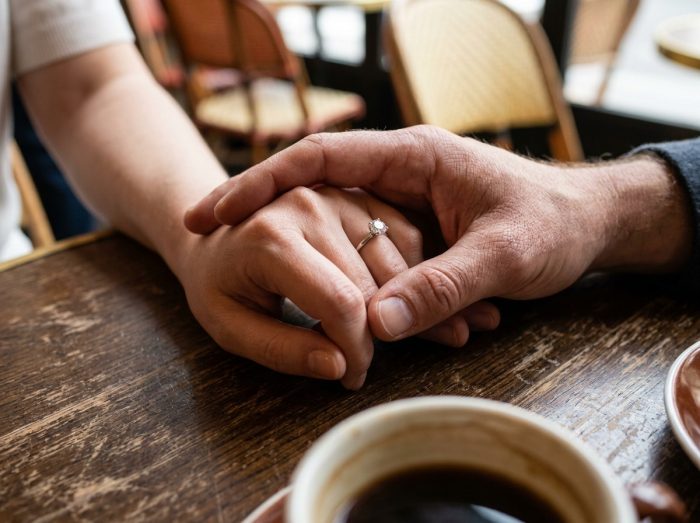
Co-designing the engagement ring: when the choice of jewelry replaces the surprise
The Knot, in its “2023 Jewelry & Engagement Study,” indicates that the majority of fiancés participated in choosing the ring. The National Jeweler Association confirms this trend: American jewelers are observing a clear increase in couples coming to the store together.
This shift has a direct consequence on the marriage proposal. When the jewelry is already known, the emotional charge shifts to the staging. The location, the chosen moment, and the possible presence of loved ones become the variables that one partner can still control to create the surprise.
On the other hand, giving a ring that the other has never seen produces a radically different effect. The opening of the box alone concentrates a large part of the emotion. The risk of error regarding style or size exists, but the gain in emotional intensity is real for couples seeking this type of moment.
What the choice of stones reveals about the couple
The diamond remains the dominant stone in the imagination of engagements, but alternatives are gaining ground. The sapphire, for example, has a royal connotation that attracts some buyers. The emerald charms with its distinctive color and relative rarity.
- The synthesized diamond meets a growing ethical demand: same brilliance, guaranteed traceability, generally lower cost than a natural diamond.
- The sapphire offers a varied color palette (deep blue, pink, yellow) and a hardness close to that of diamond, making it a durable choice.
- The emerald requires protective setting due to its fragility, but its unique character compensates for this technical constraint.
The choice of stone is no longer trivial. It reflects shared values (ethics, aesthetics, budget) and becomes a topic of discussion before the proposal, even when one partner wants to keep the surprise.
Engagement ring and ethical commitment: a criterion that weighs on the proposal
The engagement ring has become a declaration of values, not just a symbol of love. The rise of synthesized diamonds and recycled gold is profoundly changing selection criteria. For a growing number of buyers, offering a ring with transparent origins is an integral part of the gesture.
This ethical dimension also influences the use of the second-hand market. A certified vintage ring carries a story while fitting into a logic of reuse. It avoids the extraction of new raw materials without sacrificing the quality of the jewelry or its emotional impact during the proposal.
This is in line with castafiore, an online marketplace specializing in the sale of vintage and second-hand jewelry. Its catalog includes over 10,000 pieces (jewelry and watches), authenticated and certified before being put up for sale. Signed rings from major Houses or unsigned creations, each piece comes with a digital certificate of authenticity recorded in the blockchain. The platform makes 60% of its sales in France, with the rest distributed between Europe and the United States.

Wedding band and engagement ring: two objects, two functions in the proposal
The confusion between wedding band and engagement ring persists. The engagement ring comes into play at the time of the proposal, often adorned with a stone. The wedding band, exchanged on the wedding day, is generally a more understated ring.
Giving the engagement ring creates a first physical anchor of commitment, sometimes months before the ceremony. This time lag gives the proposal its own status, distinct from the wedding itself. Without a ring, the proposal remains a verbal moment. With it, it becomes an event that can be revisited by looking at one’s hand.
The tradition of wearing the engagement ring on the left hand, on the ring finger, is based on an ancient belief that a vein connected this finger directly to the heart. This convention persists in most Western countries, although some couples freely choose another finger or hand.
Thus, the engagement ring alters the marriage proposal on three simultaneous levels: it materializes the commitment before the wedding, it reflects shared aesthetic and ethical choices, and it determines whether the emotion rests on the surprise of the jewelry or on the staging of the moment. These three dimensions explain why the gesture of giving a ring remains, despite evolving practices, a pivot of the proposal.