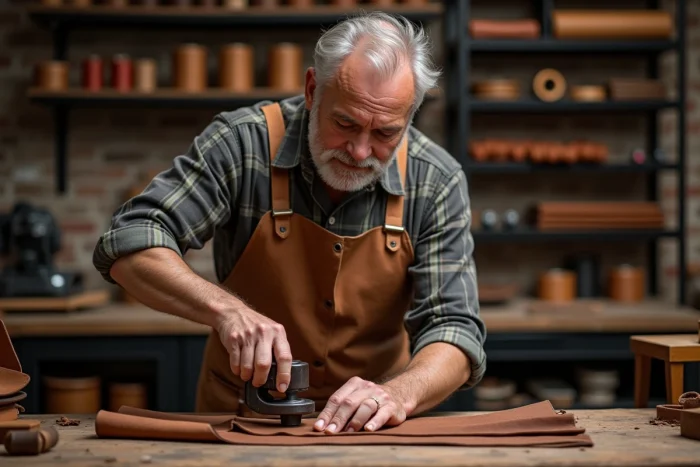
Installing a snap button, adjusting a belt, preparing a saddle stitch: every leather project goes through the same step, cleanly perforating the leather. A poorly placed or poorly sized hole weakens the piece, distorts the edge, or makes the stitching uneven. The choice of tool and striking technique makes all the difference, even on leather just a few millimeters thick.
Round hole or diamond hole: what the shape changes for leather
Before choosing a tool, it’s important to understand why the shape of the hole matters as much as its diameter. A perfectly round hole, like that of a punch or a drill, removes material. The leather around the hole no longer has supporting fibers, making it more fragile under tension.
A diamond hole, produced by an awl or a stitching claw, spreads the fibers without cutting them. The thread fills the gap, and the fibers tighten around it. A diamond hole resists tearing better than a round hole, which is why traditional saddlery and leather goods consistently use it for stitching.
The round shape remains relevant for attaching accessories: rivets, snap buttons, eyelets. These metal pieces require a free and calibrated passage. However, for any stitching subjected to mechanical stress, the diamond shape is preferable. As detailed in a leather perforation guide on Zazie Web, adapting the shape of the hole to the type of fastening avoids many disappointments in the finished product.
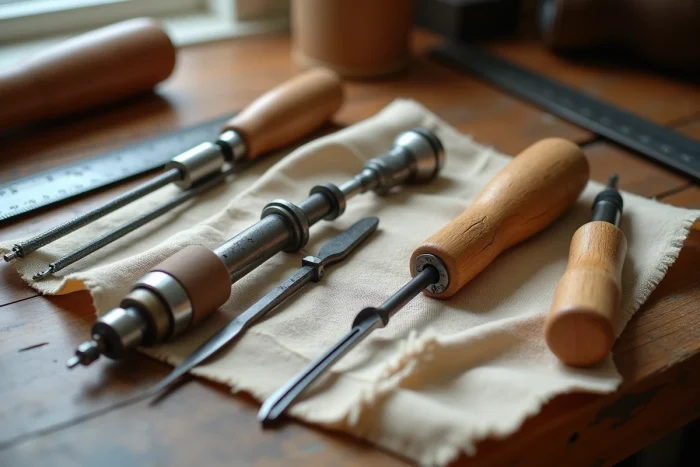
Tools for perforating leather: claw, punch, and rotary pliers
You may have noticed that some artisans align their stitching holes with perfect regularity? It’s not a matter of skill; it’s the tool that guides the action.
Striking stitching claw
The stitching claw is a row of teeth (often four to ten) mounted on a metal handle. It is placed on the leather, struck with a mallet, and it pierces several aligned holes in one go. The claw ensures a regular spacing between holes, resulting in visually neat stitching.
The teeth come in a diamond profile (called “diamond”) or a more rounded European profile. The diamond profile is the most common for saddle stitching. In recent years, several manufacturers have offered claws with replaceable teeth: when a point dulls or bends on very dense leather, it can be individually unscrewed instead of having to buy a whole new claw. This development reduces long-term maintenance costs.
Diamond awl
The awl is a single-point tool, held like a pen. It is used to pierce one hole at a time, with precise control over the angle and depth. On curves or narrow pieces, where the claw cannot pass, the awl takes over.
The awl is held at a constant angle so that each hole has the same orientation. If the angle varies from one hole to another, the stitching thread does not position itself the same way, and the line appears messy.
Rotary punch
The rotary punch resembles a classic plier with a barrel of several hollow tubes of different diameters. You turn the barrel to select the size, position the jaw, and squeeze. The hole is round and clean.
This tool is suitable for belts, watch bands, and straps. It does not require a mallet or striking surface, making it convenient for travel or on a lightweight work surface. The limitation: it only works on leather of moderate thickness and at a distance from the edge compatible with the depth of the punch.

Striking surface and leather preparation before perforation
The tool does not do it all. The surface on which the leather rests at the moment of striking directly influences the sharpness of the hole.
- A hardwood block (boxwood, lignum vitae) or high-density polyethylene absorbs the impact without bouncing back. It also protects the points of the claw, which dull quickly on a surface that is too rigid, like metal or glass.
- A nylon or wooden mallet strikes the claw without damaging it. A metal hammer crushes the top of the handle and deforms the claw over time.
- Before striking, tracing the stitching line with a dry-point compass helps guide the claw. The compass line prevents deviations that the eye alone cannot correct over a length of more than a few centimeters.
If the leather is particularly thick or stiff, lightly moistening the perforation area with a sponge makes it easier for the teeth to penetrate. Wet leather is easier to pierce, but it must be allowed to dry before stitching so that the fibers regain their hold.
Hybrid claws and drills: recent trends in leather goods
You may sometimes hear about Japanese “pricking irons.” These claws do not penetrate the leather: they only mark the surface with fine points. The hole is then finished with the awl, one by one. This hybrid method takes more time, but it gives total control over the depth and angle of each hole. High-end saddlers are increasingly adopting it.
On the opposite end, some use mini-drills at very low speeds to penetrate stacks of thick leather, especially in prototyping. Drills produce round holes that weaken the stitching, which reserves them for pieces not subjected to high tension. For a final project, the claw or awl remains more reliable.
The current trend is towards modular tools and increasingly fine tooth profiles, which leave discreet marks on the finished leather. The choice between a through claw, pricking iron, or just an awl depends on the desired finish and the type of leather being worked.
A good stitching hole is judged by the regularity of the line and the hold of the thread under tension, not by the speed of execution. Taking the time to choose the right combination of tools, prepare the surface, and trace before striking makes the difference between amateur work and a durable piece.