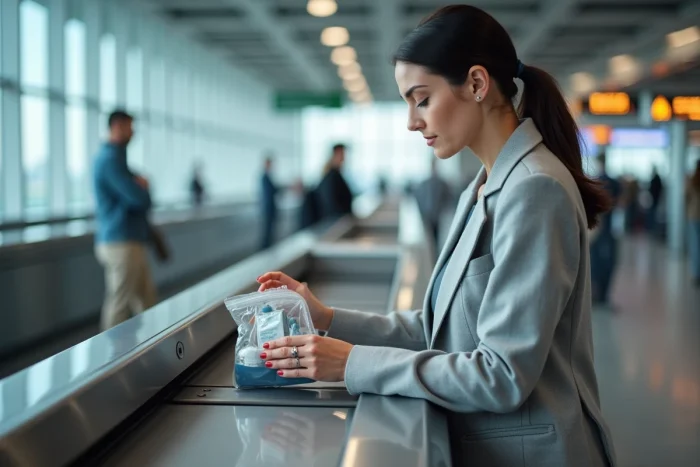
You are packing your carry-on suitcase and your tube of toothpaste raises a doubt. This everyday product falls under specific regulations that apply to all airports in the European Union. Toothpaste in carry-on luggage is allowed, but under conditions of format and packaging.
Why toothpaste is classified among liquids on planes
This question often surprises people. Toothpaste is not a liquid in the common sense. Aviation regulations adopt a much broader definition: any product with a pasty, gelatinous, or creamy consistency is treated as a liquid. Shower gels, sunscreens, shaving foams, jams, and even some soft cheeses fall into this category.
Regular toothpaste tubes, whether gel or paste, therefore rightfully fall within the scope of restrictions on liquids in the cabin. This classification is based on the aviation safety standards applied throughout the European Union and adopted by most countries worldwide through ICAO recommendations.
Before finalizing your toiletry bag, it is useful to understand the conditions for taking toothpaste in carry-on luggage without risking confiscation at security control.
100 ml rule for toothpaste in the cabin: practical application
Your tube of toothpaste must not exceed 100 ml of capacity indicated on the packaging. Note: it is the volume of the container that counts, not the actual amount inside. A 150 ml tube that is half empty will be refused at security control.
This tube must then be placed in a transparent, resealable plastic bag, with a maximum capacity of one liter. You are allowed only one transparent bag per passenger. All your liquid products, gels, and pastes must fit inside.
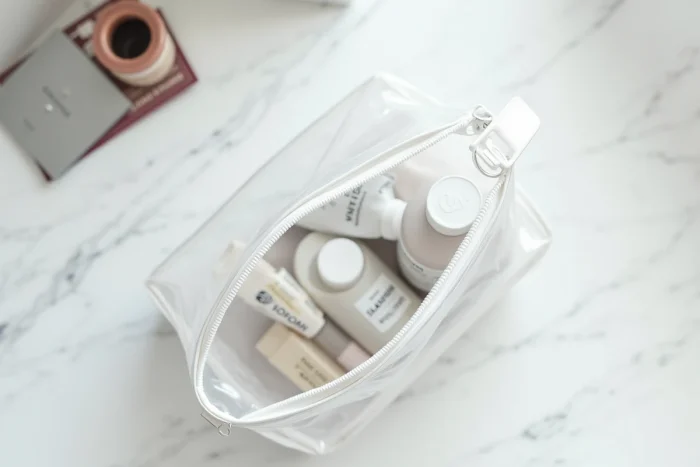
Here is what the bag must contain at the time of passing through security:
- Each container is a maximum of 100 ml, whether single-use or refillable
- The bag is transparent, measures approximately 20 x 20 cm, and closes with a zip or pressure
- The total volume of all containers combined does not exceed one liter
If your usual toothpaste exceeds 100 ml, you have two options: transfer a dose into a mini refillable bottle, or place the original tube in your checked baggage, where volume restrictions are much more lenient.
Toothpaste formats that escape the liquid rule
Not all toothpastes are subject to this limit. Solid toothpastes, in tablet or powder form are not classified as liquids. They can travel in the cabin without going through the transparent bag and without volume constraints.
Chewable tablets can be easily found at pharmacies or online. You pop one in your mouth, chew, and then brush with a wet toothbrush. The powder format works on the same principle: a small box is sufficient for several weeks of travel.
These alternatives offer a practical advantage beyond airport security. They free up space in your transparent bag for other products (moisturizing cream, hand sanitizer, serum). For a short flight or a weekend, solid toothpaste really simplifies the preparation of your carry-on luggage.
CT scanners in airports: towards the end of the 100 ml rule?
Several European airports have begun installing CT scanners, a computed tomography technology that analyzes the contents of luggage in three dimensions. This equipment allows for precise identification of a product’s nature without opening the bag.
Some equipped airports are announcing the gradual removal of the 100 ml limit. Passengers would no longer need to take their toiletry bags or electronic devices out of their bags.
Application remains highly variable depending on the airports and countries. An equipped terminal in an airport does not mean that all checkpoints are equipped. As a precaution, adhere to the 100 ml rule until your departure airport explicitly confirms otherwise. Check the airport’s website before you leave.
Toothpaste in checked baggage and differences between airlines
In checked baggage, the rules change. You can carry much larger containers. Carefully close your tubes and place them in a leak-proof plastic bag to prevent leaks due to pressure changes during the flight.
Another rarely discussed point: each airline’s policy may vary in details. Carriers like WestJet classify toothpaste among liquids and gels subject to cabin limits, in accordance with international rules, but tolerances on certain formats or transit instructions may differ. Check your airline’s baggage conditions before departure, especially if you are traveling outside the European Union or connecting with multiple carriers.
- In checked baggage, prefer a zippered plastic bag around your hygiene products to contain any leaks
- In international transit, apply the strictest rule of the countries you are passing through
- The duty-free shops in the boarding area sell cabin-sized toothpaste if you forgot yours
Toothpaste in carry-on luggage poses no problem if you comply with the 100 ml format and the transparent bag. For regular travelers, switching to solid or tablet toothpaste completely removes the constraint. Keep a standard-sized tube in your checked baggage for long stays, and check the rules of your departure airport: CT scanners could soon make this organization unnecessary.