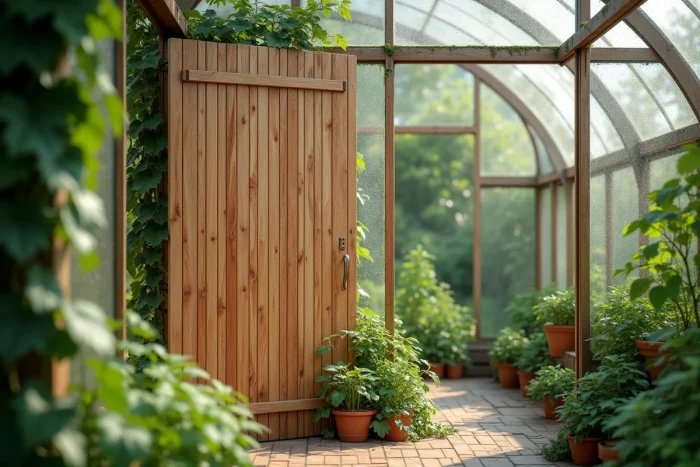
Wooden trellises, greenhouses, verandas: behind these three words lies a question of thermal regulation more than decoration. The choice of a shading system to protect a greenhouse or a veranda depends on measurable parameters: solar filtration rate, mechanical resistance, lifespan according to wood treatment. Comparing these data allows for a decision between the different options available on the market.
Wooden trellises and shading alternatives: comparative performance table
Wooden trellises are not the only shading device for greenhouses and verandas. Woven fabrics, synthetic sails, roller blinds, or plastic shade nets also occupy the market. The differences lie in durability, type of light filtration, and mechanical protection capacity.
| Criterion | Wooden Trellises | Synthetic Shade Cloth | Plastic Net |
|---|---|---|---|
| Solar Filtration | Diffuse and partial shading | Uniform shading | Variable partial shading |
| Hail Protection | Yes (window protection) | No | Partial |
| Bio-based Material | Yes | No | No |
| Custom Manufacturing | Yes (to the dimensions of the greenhouse) | Common standard sizes | Common standard sizes |
| Estimated Lifespan | Over 10 years with maintenance | Several years | Several seasons |
| Seasonal Dismantling | Possible | Easy | Easy |
The wooden trellis stands out for its dual function: diffuse shading and mechanical protection against hail. No synthetic cloth fulfills this second role. For those with a glass greenhouse exposed to the elements, this point changes everything.
The data also shows that custom manufacturing, with slats assembled on flat galvanized steel chains, allows for precise adaptation of the cover to the dimensions of each structure. One can learn everything about wooden trellises and their configurations to check compatibility with a specific greenhouse or veranda.
Wood Treatment and Actual Durability of Trellises
A bio-based material is not automatically durable. ADEME reminds us: the longevity of wood depends on the species, the treatment applied, and the actual exposure to UV and moisture. For greenhouse trellises, three finishing options exist on the market, and their performances diverge significantly.
Natural Wood, Thermal Treatment, or Chemical Treatment
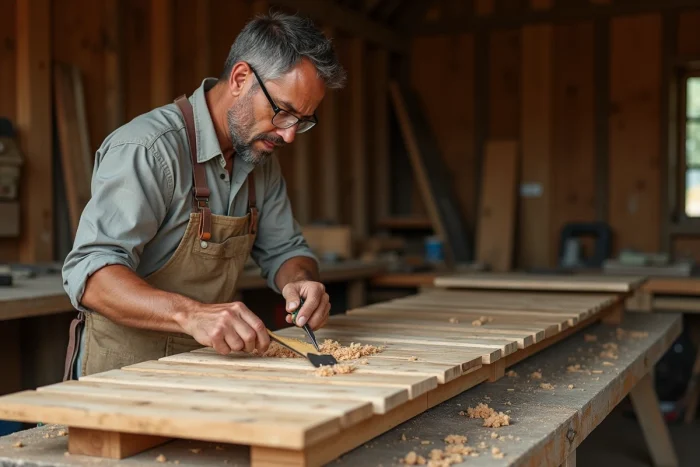
Pine slats, the main species used for trellises, come in two common sections (5 x 24 mm or 7 x 24 mm). The choice of treatment directly influences resistance and lifespan.
- Natural Wood (untreated slats): lowest cost, but vulnerable to fungi and insects if exposed to moisture frequently. Suitable for dry climates or seasonal use with winter storage.
- Thermal Treatment (Thermo Wood): heat process that provides high dimensional stability and long-lasting fungicidal and insecticidal protection, without chemicals. However, this treatment makes the slats more fragile, which directs towards the 7 mm section to compensate.
- Chemical Treatment by soaking: insecticidal and fungicidal protection through chemical means. Effective in very humid environments but incompatible with a strictly ecological approach.
The thermal treatment represents the most coherent compromise for those seeking both durability and absence of chemicals. The 7 mm section compensates for the fragility induced by the Thermo Wood process, a technical detail not to be overlooked when ordering.
Passive Climate Regulation in Greenhouses with Wooden Trellises
Shading is only part of the problem. Summer overheating in glass greenhouses can jeopardize sensitive crops. Wooden trellises act here as a tool for passive climate regulation, beyond simple light filtering.
The principle relies on diffuse shading: unlike an opaque cloth that uniformly blocks light, the spaced slats allow a fraction of radiation to pass through, varying according to the angle of the sun. In the morning and evening, when the sun is low, more light penetrates. During the hottest hours, filtration is maximized. This passive behavior requires no motorized mechanism.
For verandas used as living spaces, this natural modulation reduces indoor temperature without resorting to air conditioning. Plants grown under the greenhouse benefit from a more stable microclimate, which limits water stress and leaf burn on leaves sensitive to direct sunlight.
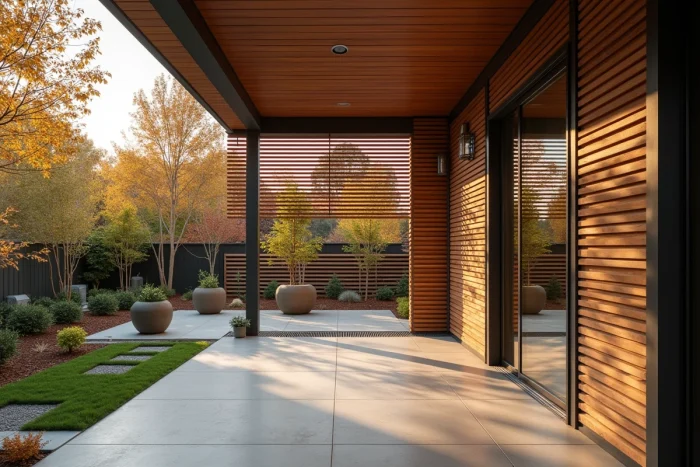
Seasonal Use and Dismantling of Trellises
The growing interest in removable shading solutions can be explained by a simple need: maximize light in winter and filter it in summer. Wooden trellises, lightweight and modular, are particularly suited for this seasonal operation.
Removing the trellises in autumn has a dual advantage. Plants benefit from maximum winter sunlight, and the wood, stored away, does not suffer from prolonged moisture that accelerates its degradation. This practice extends the lifespan of the trellises well beyond the average observed in permanent installations.
Slat Density and Shading: Adapting Trellises to the Garden and Crops
With a standard density of 30 slats per linear meter, the trellises offer a calibrated shading rate for most greenhouse uses. However, not all plants require the same level of filtration.
Understory plants (ferns, hostas, certain varieties of cuttings) tolerate pronounced shading. Fruit crops or tomato plants, on the other hand, need more direct sunlight to ensure fruit ripening. The choice of slat section (5 mm or 7 mm) alters the ratio between shade and light.
5 mm wide slats, being thinner, allow more light to pass between them. 7 mm slats cover a slightly larger area and are better suited for species that fear direct sunlight. This parameter, rarely mentioned in buying guides, nevertheless conditions the outcome for protected crops.
The last point to consider concerns the soil under the greenhouse. Well-measured shading reduces evaporation of watering water, which decreases the frequency of interventions and maintains a more regular soil moisture. For a vegetable garden under a greenhouse, this indirect effect on water management weighs as much as the solar protection itself.