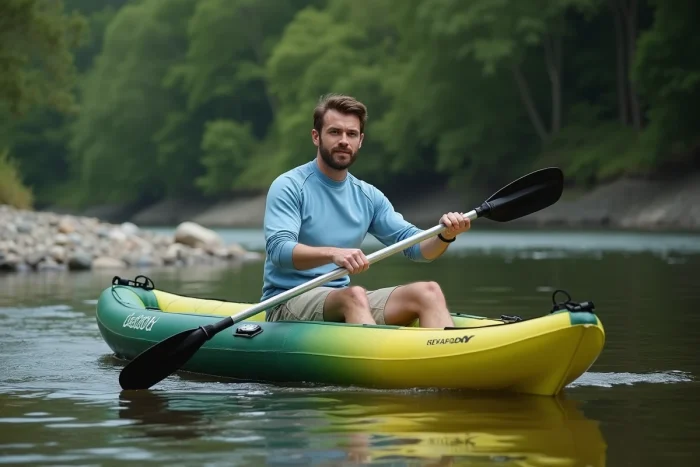
The Sevylor Tahiti Plus is a three-person inflatable canoe designed for the entry-level market. Its structure relies on welded PVC side tubes, without a rigid frame or directional fin. This technical positioning influences everything else: stability, durability, and the type of navigation possible.
Stiffness and Behavior on Water of the Sevylor Tahiti Plus
The stiffness of an inflatable canoe depends on the internal pressure of its air chambers and the quality of the welds between the PVC panels. On the Sevylor Tahiti Plus canoe, the side tubes provide buoyancy but do not offer a supporting structure comparable to a high-pressure floor or woven polyester reinforcements.
In practice, the soft bottom deforms under the weight of the occupants. The seating sinks, the waterline rises, and the hull offers more resistance to movement. On calm water (lake, canal, slow river), the craft remains functional for outings of a few hours. The paddler feels more lateral float than on an inflatable kayak equipped with a keel or fin.
The lack of a self-draining system deserves attention. In case of water entry (wave, splash, rain), water stagnates at the bottom of the canoe. Manual bailing is then required, which interrupts progress and poses a comfort issue on extended outings.
Durability of Tubes and Welds After Several Seasons
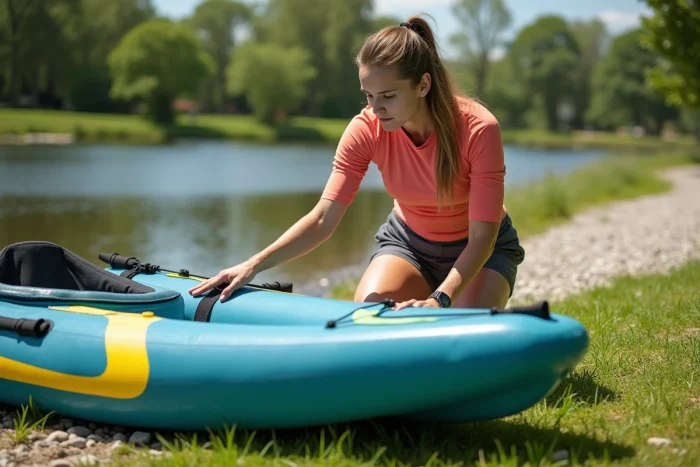
The longevity of an entry-level inflatable depends on two factors: the watertightness of the tubes and the integrity of the heat-welded seams. User feedback published in recent years indicates an increase in cases of micro-leaks on the side tubes after a few seasons of regular use.
Peeling occurs mainly in two scenarios:
- Inflated storage in direct sunlight, which subjects the PVC to repeated thermal expansion and weakens the seams
- Frequent use without rinsing with fresh water after outings in saltwater or sandy conditions, which accelerates the porosity of the seams
- Folding and storing the canoe while still damp, promoting mold growth and deterioration of the interior coating
Rigorous maintenance (complete drying before storage, deflated storage in the shade) extends the lifespan. Without these precautions, leaks appear as early as the second or third season.
Access to Clubs and Water Sports Bases: A Little-Known Limitation
Affiliated water sports bases or canoe-kayak clubs apply safety criteria on the equipment accepted during guided outings. In recent years, several organizations have refused the Tahiti Plus for group outings, even on class II rivers.
The reasons cited align with the product’s technical characteristics: low structural stiffness, absence of a fin, no self-draining. For a paddler looking to progress beyond calm water paddling, this refusal concretely limits the possibilities for guided outings and access to varied routes.
This point clearly distinguishes the Tahiti Plus from more advanced inflatable models (Gumotex or higher Sevylor ranges) that incorporate rigid floors, removable fins, and drainage systems. Therefore, the choice of canoe also conditions access to a structured practice environment.
Transport and Inflation in Daily Use
The Tahiti Plus fits into a transport backpack, a strong selling point for hikers or travelers without a roof rack. Inflation is done via three Boston valves, compatible with most manual or electric pumps on the market.
The inflation time remains reasonable with a double-action pump. However, deflation and folding require a bit of technique to avoid folding the seams in the same place repeatedly, which would accelerate their wear.

Sevylor Tahiti Plus: For Which Type of Paddler
This inflatable canoe serves a specific role: to provide an initial low-budget paddling experience on calm waters, without long-term commitment. It is a coherent product for testing canoeing with family before investing in a structurally superior model.
- Suitable for lakes, canals, and slow rivers without significant current
- Enough for occasional outings of a few hours with two adults and one child
- Unsuitable for class II rivers and above, guided club outings, and navigation exposed to wind or waves
- Not recommended for multi-day trips, where seating comfort and course holding become critical
The Tahiti Plus is a beginner canoe, not a progression canoe. Confusing the two leads to disappointments in terms of performance and durability. Specialized forums are filled with testimonials from paddlers who sold their Tahiti Plus after just one season to switch to a Gumotex or a higher Sevylor model.
For those who accept these limitations and seek a compact, lightweight, and affordable inflatable for unpretentious summer outings, the Tahiti Plus fulfills its promise. The key remains not to ask it to do what it was not designed for.