
Getting your driver’s license in 2026 means facing an exam that no longer just involves reciting answers by heart. The practical test now assesses your independence in real situations, your ability to react to unexpected events, and your overall mastery of road safety.
Interior and exterior checks: what traps most candidates
During the practical test, the inspector randomly selects a question from an official bank. This question relates to a vehicle check or a safety behavior. The candidate must respond verbally and then physically show the relevant element on the vehicle.
Have you ever noticed that we often forget what we don’t practice? That’s exactly the trap. Many candidates review the checking questions like a multiple-choice quiz, without ever opening the hood or touching the controls. On the day of the exam, they know that the windshield washer reservoir exists, but they can’t locate it.
To anchor these responses, the most effective method is to get into a vehicle (either the driving school’s car or a personal vehicle) and replicate each action. Identify the headlight height adjustment, locate the night position control of the interior mirror, open the hood to show the coolant reservoir. By practicing this way, you can find the resources compiled in the driving guide on Pulsion Laval and turn them into automatic responses rather than fragile theoretical knowledge.
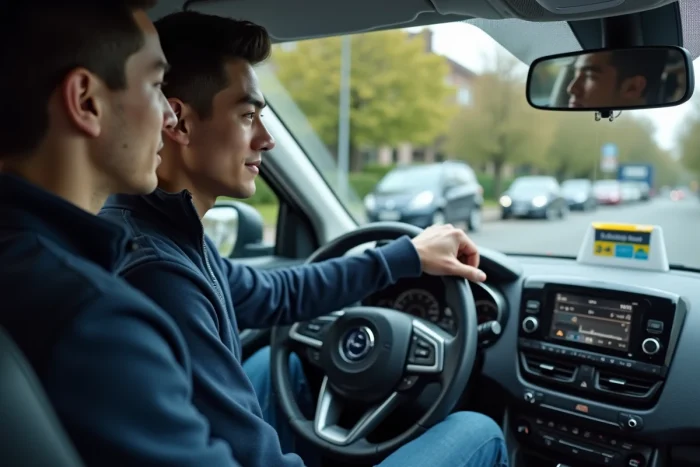
2026 License grading: understanding the grid before getting in the car
The evaluation grid for the B license is based on several families of skills. The inspector does not simply check “good” or “bad”: they observe your behavior throughout the course and assign ratings by block.
The three main evaluated blocks
- Knowing and mastering your vehicle: setting up at the driving position, using the controls, managing steering and braking. A candidate who stalls at the start loses points here, but it is not disqualifying in itself.
- Understanding the road: reading traffic signs, anticipating turns, adjusting speed to visibility conditions. This block reveals whether you are driving “ahead” on the road or reacting at the last moment.
- Sharing the road with other users: respecting priorities, communicating with pedestrians, managing intersections. This block often concentrates disqualifying errors.
A disqualifying error is not necessarily spectacular. Running a red light is, of course. However, failing to check the blind spot before changing lanes is enough to disqualify a candidate, even if the rest of the course was correct.
What the inspector is really looking for
The grading values autonomy. A candidate who adapts their driving without waiting for the instructor’s instructions earns points. Conversely, someone who always waits to be told to turn or slow down shows a lack of decision-making.
The test evaluates behaviors, not recited knowledge. You can know the highway code perfectly and fail if your reflexes in real situations do not follow.
Road safety and first aid: questions that no one reviews enough
Beyond technical checks, the exam includes questions about behavior in emergency situations. The population alert and information system (SAIP) is part of the question bank. Specifically, you may be asked how to react when the alert signal sounds.
The expected response follows three steps:
- Get to safety immediately
- Inform yourself via media and official authority websites as soon as possible
- Follow the instructions issued by the authorities
Questions about first aid in the presence of a victim follow the same logic. You will be asked how to protect a danger zone after an accident. The answer: clearly and widely delineate the area to protect victims and prevent a secondary accident.
These questions may seem simple when calm. On exam day, stress muddles thoughts. The solution: rephrase each answer in your own words rather than memorizing set phrases.

Preparing for the driving exam with digital tools in 2026
The digital training offer has significantly evolved. Mobile applications provide series of questions with immediate correction, course simulations, and daily verification reminders.
Why do these tools change the game? Because they allow you to review in micro-sessions of a few minutes, which promotes long-term memorization. Rereading a PDF of questions for two hours the day before the exam works much less effectively than ten minutes a day for three weeks.
A point of caution: compilations of questions labeled “2026” circulating online are often private initiatives, not official documents published by the administration. Check that your review sources correspond to the actual question bank used by inspectors. Content from recognized driving schools or platforms like Codes Rousseau offers more guarantees on this point.
Preparing for the license is not just about accumulating driving hours. Understanding the evaluation grid, practicing checks on a real vehicle, and regularly reviewing road safety questions are three concrete levers to approach the test with a real advantage. The most effective approach remains to combine these methods rather than relying solely on one review channel.