
A death anniversary is not managed like a recent mourning. The register changes, as do the expectations of the bereaved person. Writing a condolence message for the anniversary of a friend’s death requires calibrating the tone between memory and presence, without slipping into funeral solemnity or banality.
Specific tone of a message addressed to a friend on a death anniversary
The friendship relationship imposes a register that classic condolence guides do not cover. A message intended for a family member is based on deference. One addressed to a friend is based on the shared closeness with the deceased.
We recommend starting from a concrete memory rather than an abstract formula. Evoking a moment experienced together anchors the message in the reality of the relationship, not in a generic model.
Three axes structure a fitting text for this specific situation:
- Name the deceased by her first name, not by a periphrase (“your mom,” “the one who was dear to you”). Friendship allows for this familiarity, and it makes a difference.
- Mention a character trait or a shared episode. The specific memory proves that the deceased person still matters, beyond the date.
- Formulate a proposal for action rather than a vague availability. “I’ll call you tonight” is better than “feel free if you need anything.”
To delve deeper into this angle with examples of texts suited to the friendship relationship, you can consult Puériculture Bébés, which develops several formulations according to the degree of intimacy.

Writing a short or long mourning message: criteria for choice
The current trend in grief support resources values short, present, and concrete messages rather than long literary texts. This is not a simplification; it is a refocusing on what truly helps the bereaved person.
Short message: when and how
A message of two to four sentences is suitable when the relationship with the deceased was indirect, or when you have no personal memory to draw upon. The goal is to signal your presence without forcing interaction.
Example of an effective structure: one sentence of thought (“I’m thinking of you on this date”), one sentence of memory (“I miss Marie’s laughter too”), one sentence of action (“I’ll come see you on Sunday if you want”).
Long message: pitfalls to avoid
A long condolence text works only if each sentence brings a distinct element. Repeating the pain in three different synonyms consoles no one. A successful long message contains a memory, a quality of the deceased illustrated by a fact, and a direct address to the grieving friend.
The most common pitfall in long texts remains the accumulation of solemn phrases borrowed from the family register. “Sincere condolences” or “in this painful ordeal” create an artificial distance between friends.
Formulations to favor and words to avoid for a death anniversary
The vocabulary of mourning follows implicit conventions. Certain formulations, acceptable during funerals, become inappropriate a year or several years later.
- “I remember…” followed by a specific fact works better than “she will remain in our hearts,” which has become a phrase emptied of meaning through use.
- “This date makes me think of her” is preferable to “on this sad anniversary,” which sends the bereaved person back to their pain rather than to the memory.
- “How are you doing these days?” opens a space for conversation. “Courage” or “be strong” closes it.
- Naming a personal emotion (“it still touches me”) creates a connection. Passive phrases (“that’s just how life is”) create emptiness.
We observe that the most helpful messages name the deceased and address the living, in that order. The memory first, the bond next.
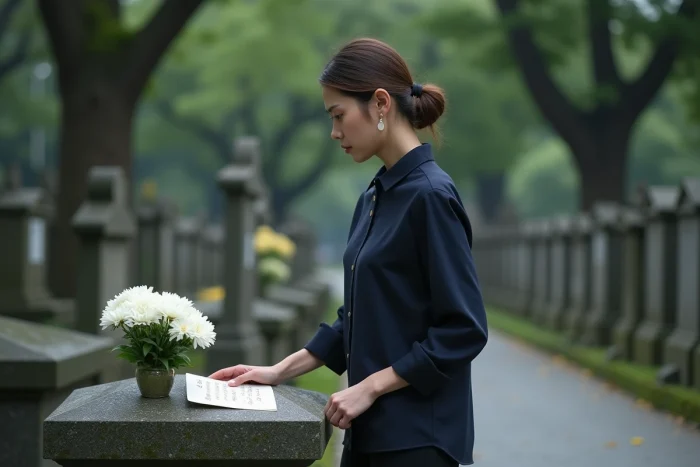
Anticipating the commemoration day: sending the message at the right time
The timing of sending is a parameter that most guides overlook. Recent grief support resources recommend contacting the bereaved person in advance rather than on the day itself, to allow them the choice of reading the message when the emotional burden is highest.
Sending a message the day before or two days before allows the friend to know she is not alone, without imposing an interaction on the anniversary of the death. If the person prefers to go through this day in peace, the message will have already fulfilled its function.
The channel also matters. A text message or a private message remains discreet. A post on a social network, even if well-meaning, exposes the mourning to an unchosen audience. For a death anniversary, a personal and private message respects the intimacy of the loss more.
Follow up or not after sending
Not receiving a response does not mean that the message did not matter. Grief, especially on an anniversary date, can make any interaction difficult. A condolence message does not require a mandatory response. If you wish to maintain the connection, propose a concrete moment a few days later rather than following up on the initial message.
The anniversary of a friend’s death comes around every year. The first is often the most dreaded, but the following ones are not simpler. Adapting the message over the years, by recalling different memories or acknowledging the journey taken, shows that the memory of the deceased evolves over time, without fading.