Hybrid formulations are redefining the makeup reading grid. Foundations loaded with niacinamide, blushes formulated with hyaluronic acid, lipsticks incorporating peptides: the boundary between skincare and makeup is no longer technically relevant. This convergence alters purchasing criteria and necessitates rethinking how we build a beauty basket.
Hybrid skincare-makeup formulations: what changes in textures
The current generation of foundation products no longer settles for a mere active ingredient. L’Oréal Paris, Shiseido, and Fenty now incorporate high-protection sunscreen filters, stabilized niacinamide, and low molecular weight hyaluronic acid directly into the aqueous phase of their foundations. The associated technical files mention clinical tests focusing on long-lasting hydration and improvement of the skin barrier.
We observe the same movement with cream blushes and tinted lip balms. A peptide-formulated blush acts on the skin beyond just color payoff. The makeup gesture becomes a skincare gesture, simplifying the routine but complicating the decoding of INCI lists for those wanting to compare two references.
For those wishing to explore these new references without getting lost, accessing shopping on Makeup Chic allows filtering by active ingredient or type of formulation, which speeds up selection.
Virtual try-on and AI recommendation
In-store testing remains useful, but the majority of beauty purchase decisions begin on screen. Sephora, MAC, Nars, and L’Oréal report a significant increase in the use of their virtual try-on tools since the end of 2023. The principle is simple: a front-facing camera, a facial detection algorithm, and real-time rendering of the shade on the skin.
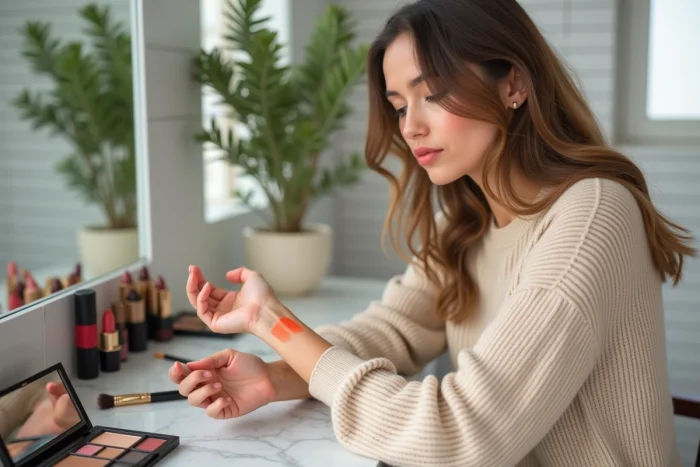
Virtual try-on significantly reduces the return rate on foundation purchases. When the algorithm correctly maps the skin undertone (warm, cool, neutral), the shade match is more reliable than a quick test on the back of the hand in-store.
We recommend checking three points before relying on these tools:
- Screen calibration: an overly saturated screen distorts the rendering. Disable night mode and blue light filter before trying.
- Ambient lighting: yellow artificial light skews all undertones towards warm. Prefer indirect natural light.
- Database coverage: some tools only offer the brand’s range. Multi-brand aggregators provide a broader comparison.
Natural complexion and bitten lips trend: textures to favor in spring
The return of the “no makeup” look does not mean less product. It means a better-formulated product, with a skin-like finish that does not emphasize pores. Serum-foundation textures, very fluid, are gradually replacing traditional full-coverage foundations for daily use. A well-pigmented tinted serum covers as much as a medium foundation while feeling lighter on the skin.
On the lips, the “bitten lip” trend dominates spring. The principle: a lipstick applied with the finger, blended outward, for a gradient that mimics a naturally pigmented lip. Matte dry formulas do not work for this effect. We favor velvet textures or saturated tinted balms, which remain flexible long enough to be worked.
Cream blush, applied high on the cheekbone and slightly on the bridge of the nose, completes this “natural flush” look. Cream blush and bitten lips in the same chromatic family unify the look effortlessly. A raspberry pink on the cheeks and a blended berry on the lips create a coherence that traditional powdered makeup struggles to reproduce.
Colored eyes and jumbo eyeliner: technical gestures that change the result
Blue and purple are settling on the eyelids for the spring-summer season. Rihanna has been photographed with electric blue eyeshadow, and the trend ranges from cobalt to glacier blue depending on skin tones. The classic pitfall: applying a bright color on an unprepared eyelid, which causes a color shift within hours.
An eyeshadow primer is the only factor that guarantees the longevity of a pigmented shadow. Without it, blue and purple pigments migrate into the crease and lose their intensity. Apply the primer, let it dry for about thirty seconds, then apply the shadow by tapping rather than stretching.
The jumbo eyeliner, brought back into focus by several makeup artists this season, simplifies the graphic line. Its thick, flexible tip allows for a single-pass line, whereas a fine liner requires a very steady hand. For a clean result:
- Gently pull the temple to stretch the eyelid while lining.
- Start from the outer corner and move inward, not the other way around.
- Set with a dry shadow of the same shade tapped over the still-wet line.
- Clean up smudges with a cotton swab soaked in micellar water, not oily makeup remover that would smear the pigment.
Mascara and eyebrows: two areas where technique matters more than product
A mascara applied in a zigzag from the root deposits more product than a classic vertical motion. The zigzag movement separates the lashes while evenly loading them. Two coats are sufficient: the first structures, the second densifies. A third coat almost always creates clumps.
For eyebrows, the trend remains structured-natural. A tinted gel brushed upwards sets the hair without a “stiff” effect. Micro-tip pencils allow filling sparse areas hair by hair, resulting in a more credible look than uniform powder filling.
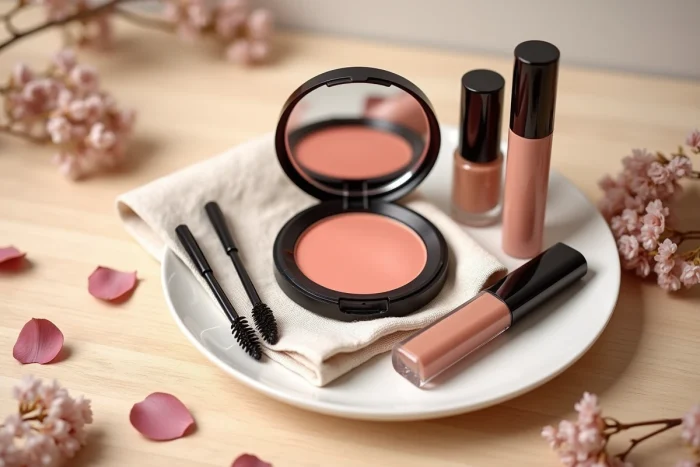
The choice of an eyebrow product primarily depends on the natural density of the hair. A full brow only needs a clear gel. A fine or sparse brow benefits from combining a micro-tip pencil on empty areas and a tinted gel for finishing. Layering three products (powder, pencil, gel) weighs down the look and ages the appearance.
The spring-summer season leans towards less product and more precision. Hybrid products, virtual try-on tools, and lightweight textures converge towards makeup that is considered as much a skincare gesture as an aesthetic one. The most reliable selection criterion remains the ingredient list, not the packaging.