Brittany boasts a density of sweet specialties that few French regions can claim. Semi-salted butter, yeast dough, slow cooking: Breton pastries share a common technical foundation, but each relies on a gesture or an ingredient that sets it apart. Compiling a list of ten sweets requires looking beyond the tourist showcases.
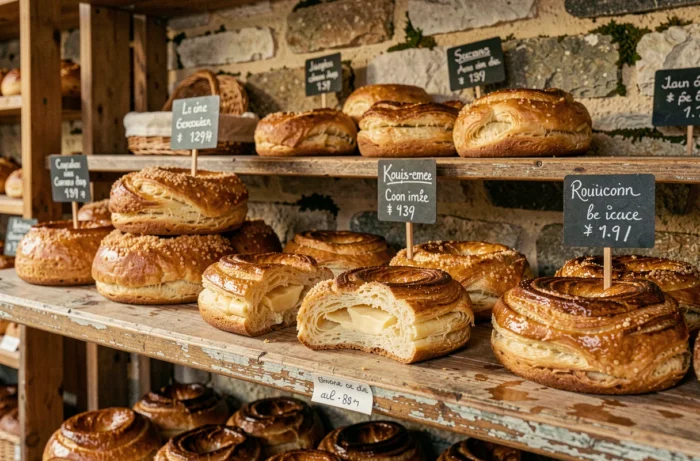
Kouign-amann: a registered name, a misunderstood technique
The kouign-amann is now found in bakeries around the world. Its international spread accelerated after its introduction in a New York bakery in 2011, before being offered in several major American cities. This popularity has blurred the line between the original product and its imitations.
The authenticity of the recipe relies less on the list of ingredients than on the technique. The version associated with Douarnenez uses a yeast bread dough, with gradual incorporation of butter and sugar through successive folds. The baking must produce caramelization of the bottom and edges, not just a golden puff pastry. A kouign-amann that is soft in the center, without a caramelized crust, has not been made according to this method.
To better situate the pastry specialties of Brittany in their context, it should also be noted that the name “Véritable Kouign Amann de Douarnenez” was registered with the INPI on December 15, 1999. This action distinguishes the recipe claimed by Douarnenez from the generic versions sold under the same name. The historical attribution to baker Yves-René Scordia, on the other hand, remains poorly documented: no archive dated from the 19th century formally confirms it.
Far breton and gâteau breton: two pastries that are worlds apart
Far breton and gâteau breton are often mentioned side by side, as if one were a variant of the other. Their kinship stops at geographical origin.
Far breton, an oven-baked flan
The traditional far breton is a liquid batter (flour, eggs, milk, sugar) poured into a dish and baked for a long time. Its texture lies between flan and clafoutis. The version with prunes dominates, but the plain version, without fruit, corresponds more closely to the original peasant recipe.
The success of the far depends on the cooking time and the milk-flour ratio. Too much flour results in a compact block. Not enough cooking leaves a raw center. Salted butter is mainly used in the mold and on the surface, unlike in kouign-amann where it constitutes half of the mass.
Gâteau breton, a dense and golden shortbread
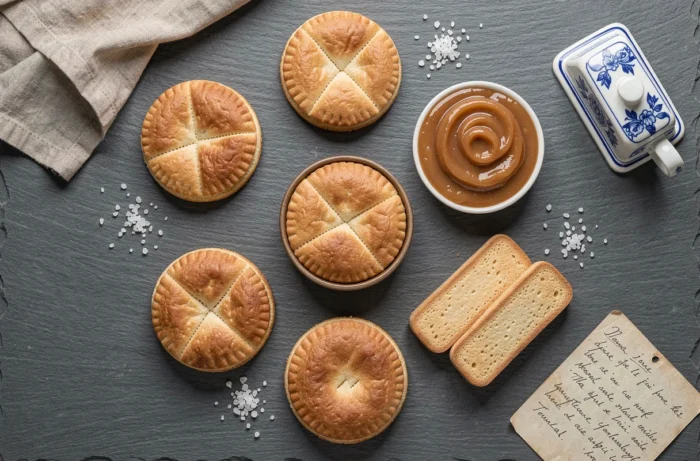
The pure butter gâteau breton is a thick shortbread dough, golden from egg yolk, with a texture reminiscent of compact shortbread. It keeps for several days due to its low water content. Its cracked crust and crumbly interior make it a travel cake, historically taken by sailors.
The fundamental difference: the far is moist and eaten fresh, while the gâteau breton is dry and keeps well. Confusing them is like comparing a flan to a shortbread.
Breton biscuits: palets, galettes, and crêpes dentelles
Brittany produces a family of dry biscuits distinguished by their shape and cooking, not just by their name.
- Palets bretons are thick, crumbly, with a tender center. Their thickness requires controlled baking to avoid a raw center beneath an overly golden crust.
- Breton galettes are thinner, crunchier, and often contain less butter than palets. The term “galette” here refers to the biscuit, not to be confused with the savory buckwheat galette.
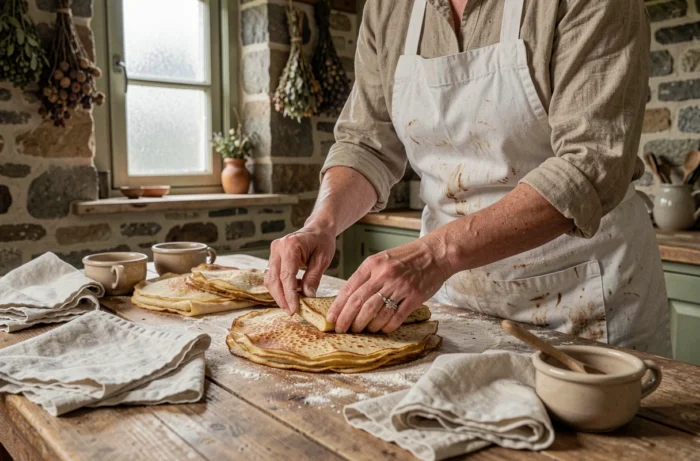
- Crêpes dentelles are said, according to tradition, to result from a cooking accident: a crepe forgotten on the billig, becoming thin and brittle. They are rolled into a cylinder and break at the first touch. Their crispy texture makes them both a dessert accompaniment and an independent biscuit.
Pont-Aven remains associated with palets and galettes thanks to the Traou Mad brand, but the production of Breton biscuits spans the entire region, with artisanal bakeries in Morbihan, Côtes-d’Armor, and Finistère.
Salted butter caramel and quatre-quarts: less technical Breton specialties
Not all Breton sweets require a baker’s skill. Salted butter caramel and quatre-quarts are accessible, which explains their omnipresence in regional grocery stores.
Breton salted butter caramel
Breton salted butter caramel is based on a simple principle: a classic caramel to which semi-salted butter and cream are added. The quality of the butter determines the result. A Breton farm butter, with its salt content and fat, produces a more complex caramel in the mouth than standard industrial butter.
Quiberon is often mentioned for its caramel confections, but production is spread across the entire Breton coastline.
Breton quatre-quarts
The quatre-quarts gets its name from its recipe: a quarter of flour, a quarter of sugar, a quarter of butter, a quarter of eggs. The Breton version is distinguished by the systematic use of semi-salted butter, which adds a salty note absent from versions from other regions. The result is a dense, moist cake, without frills.
Crêpes and buckwheat galettes: the sweet-salty foundation of Brittany
Breton crêpes are not pastries in the strict sense, but they hold a central place in the sweet repertoire. The wheat crêpe, filled with butter-sugar, caramel, or jam, remains the most consumed dessert in Brittany.
The buckwheat galette, on the other hand, falls into the savory category. Buckwheat (sarrasin) used for the galette is an emblematic ingredient of Breton cuisine, present in creperies throughout the region.
The two preparations share a tool: the billig, the round cast iron cooking plate. The gesture of the crêpe turner is part of the intangible Breton heritage, just like the recipes themselves.
The ten Breton sweets cover a wide spectrum, from the caramelized puff pastry of kouign-amann to the simplicity of quatre-quarts. Their common point remains semi-salted butter, an ingredient that has shaped a pastry heritage that the region continues to defend, between registered names and artisanal production.