The confusion between Polo Club and Ralph Lauren is based on a precise mechanism: two mounted riders, two logos that appear similar, but two legal and industrial structures with no capital link. Understanding the difference between Polo Club and Ralph Lauren requires going beyond the visual and examining the construction of each brand, its distribution channels, and the actual quality of its products.
Labels and Trademarks: What a Technical Reading of a Label Reveals
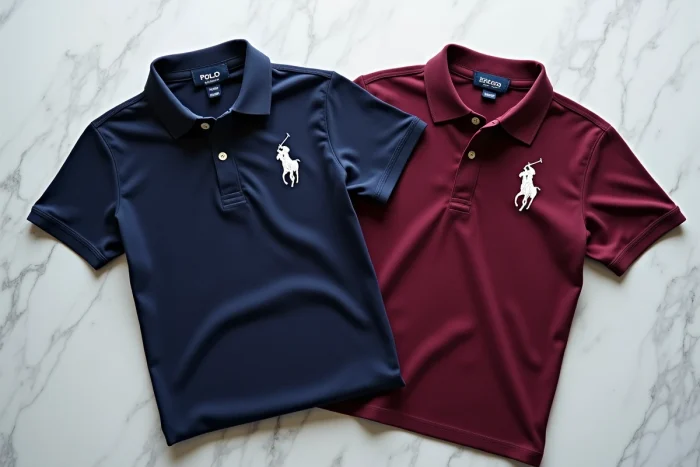
The first reliable reflex is to examine the inner label. On a Polo Ralph Lauren product, the full mention “Polo by Ralph Lauren” or “Polo Ralph Lauren” systematically appears, accompanied by the rider holding a mallet raised to the right. The logo is a registered trademark of Ralph Lauren Corporation.
Products stamped “Polo Club” (sometimes appearing as “Royal County of Berkshire Polo Club,” “Santa Barbara Polo & Racquet Club,” or “U.S. Polo Assn.”) use riders that are graphically similar but never identical. The orientation of the horse, the posture of the player, and the typography of the text under the logo differ. Polo Club is not a sub-brand of Ralph Lauren: it is a distinct entity, often linked to polo federations or independent commercial licenses.
In Europe, the tightening of rules against misleading claims and visual imitation of brands has made the use of signs similar to “Polo” more legally sensitive. To better understand the difference between Polo Club and Ralph Lauren, one must also examine the disputes surrounding these names, which have multiplied and push each entity to clarify its visual identity.
Polo Ralph Lauren in the Architecture of Ralph Lauren Lines
Polo Ralph Lauren is the most widely distributed line of Ralph Lauren Corporation. It positions itself in a mid-range segment, between accessible ready-to-wear (Lauren Ralph Lauren) and high-end lines (Purple Label, Double RL). This is the line found in most department stores and standalone boutiques.
The Ralph Lauren Corporation structures its ranges according to a precise hierarchy:
- Purple Label: handcrafted, Italian fabrics, luxury positioning comparable to major European houses.
- Polo Ralph Lauren: high-end sportswear, iconic polos, oxford shirts, knitwear. The core of the brand in terms of volume.
- Lauren Ralph Lauren: more accessible women’s line, widely distributed in department stores.
- Double RL (RRL): workwear and Americana line, limited production, clientele of connoisseurs.
Polo Club, on the other hand, does not fit into any such architecture. Its collections are not attached to a group structured around an identified creator. The brand most often operates under license, with manufacturers and distributors varying by geographical markets.
Materials and Manufacturing: A Gap That Can Be Felt
We observe on Ralph Lauren polos a piqué cotton whose weight is dense enough to maintain its shape after several dozen washes. The seams are reinforced at the armholes, the buttons are made of genuine mother-of-pearl on the most refined lines, and the dye retains its depth over time.
Polo Club pieces adopt a significantly lower price positioning. The cotton used is generally finer, and the knit is less tight. This is not a flaw in itself: it is consistent with a lower selling price. The problem arises when the consumer buys a Polo Club thinking they are acquiring a Ralph Lauren product.
Ralph Lauren has also strengthened its commitments regarding traceability and material compliance, with sustainability goals documented in its annual report. This level of industrial structuring and ESG transparency has no equivalent among the public Polo Club brands.

Distribution and Direct Sales Strategy: The True Marker of Positioning
Ralph Lauren now prioritizes direct sales (own stores, official e-commerce) rather than distribution through multi-brand outlets. This strategy, accelerated in recent years, aims to control brand image and maintain prices. Ralph Lauren stores offer a scenographed experience, with a coherent lifestyle universe.
Polo Club products can be found in very different channels: markets, entry-level multi-brand boutiques, general online sales platforms. This geographical and price accessibility reinforces the confusion, as consumers encounter these products in contexts where they do not expect to have to verify the true origin of the brand.
Identifying a Fake Ralph Lauren vs. an Authentic Polo Club
The most frequent question concerns counterfeiting. Polo Club is not a counterfeit of Ralph Lauren: it is a legal, distinct brand. However, counterfeits of Ralph Lauren sometimes borrow visual codes similar to those of Polo Club, further blurring the lines.
To authenticate a Ralph Lauren product, we recommend checking three elements:
- The presence of the full name “Ralph Lauren” or “Polo Ralph Lauren” on the inner label, never a simple isolated “Polo.”
- The quality of the rider’s embroidery: on an authentic piece, the threads are tight, the mallet is distinct, and the horse’s hooves are detailed.
- The composition and country of manufacture label, which must be sewn (not glued) with regular typography.
A Polo Club sold at its real price is not a problem. The risk arises when the visual blur between the two brands is used to justify an inflated price on a product that has no link to the Ralph Lauren house. Checking the label before purchase remains the most reliable action, whether in-store or on the second-hand market.