
The symbol ∞ is one of those signs that everyone recognizes without necessarily knowing where it comes from. This lying eight, found on jewelry, tattoos, and math textbooks, has a specific name: the lemniscate. Its history intertwines geometry, philosophy, and typographic conventions, and its meaning varies depending on the field in which it is used.
The lemniscate before mathematics: a motif older than we think
Have you ever noticed that the shape of the lying eight appears everywhere in ancient art? Celtic ritual knots, Roman ornaments, intertwined ribbons on pottery: this motif circulated long before mathematicians took hold of it.
Several historians of mathematics now nuance the idea that John Wallis invented the symbol ∞ out of nothing. Researchers like Eleanor Robson (University College London) remind us that similar signs already existed in non-mathematical contexts, in the form of ribbons or ligatures. Wallis, in 1655, would have thus reinterpreted a graphic motif that was already widespread rather than created an entirely new symbol.
This nuance changes the perspective. The infinity sign does not arise from a solitary flash of genius. It emerges from a long visual tradition where the endless loop already intuitively represented the absence of limits. To delve deeper into the meaning of the infinity sign, this lineage between ornamentation and mathematical abstraction deserves to be kept in mind.
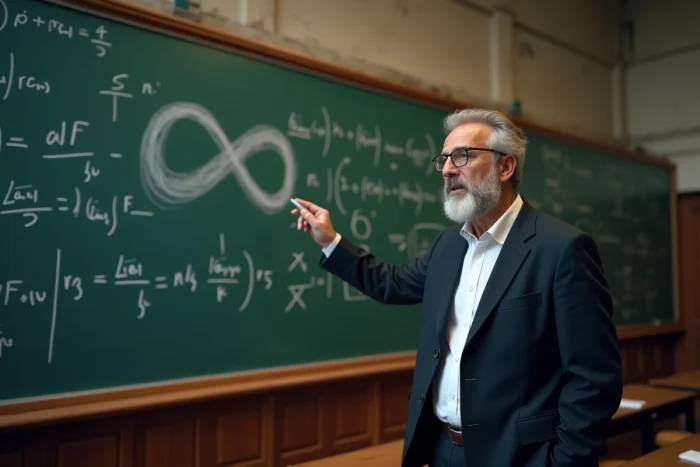
John Wallis and the entry of the symbol ∞ into mathematics
In 1655, the English mathematician John Wallis introduced the sign ∞ in his work De sectionibus conicis. Why this graphic choice? No absolute certainty exists. Several hypotheses coexist.
The first links the symbol to the Latin ligature of the word “mille” (CIƆ or M), which was already used to express a very large quantity. The second sees it as a reference to the geometric curve that Jacques Bernoulli would later name “lemniscate” (from the Latin lemniscus, ribbon). Wallis gave the sign a formal use that no one had established before him.
What makes his contribution decisive is not the shape itself, but the fact that he associated it with a specific mathematical concept. Before Wallis, infinity remained a philosophical or theological idea. After him, it became a calculation tool, usable in formulas and reasoning.
The name “lemniscate” and Bernoulli’s curve
The term lemniscate primarily refers to a geometric curve studied by Jacques Bernoulli at the end of the 17th century. This curve, drawn in a plane, resembles a lying eight. Its equation produces two symmetrical loops that intersect at a central point.
The curve and the symbol share the same shape but not the same function. One is a geometric object with measurable properties. The other is notation, a shorthand for saying “without limit.” The two have mutually nourished each other: the curve popularized the shape, and the symbol gave the word lemniscate a second life outside of pure geometry.
What the symbol ∞ really means in contemporary mathematics
Contrary to what common usage suggests, the sign ∞ does not represent a number. It cannot be added, multiplied, or compared to an integer as one would with 7 or 42. It is a writing convention, and its meaning changes depending on the mathematical context.
- Arithmetic infinity (extended reals): used in limits and improper integrals, it indicates that a value grows without bound. When we write “limit as x approaches ∞,” we do not say that x reaches infinity, but that it surpasses any fixed threshold.
- Cardinal infinity (set theory): here, ∞ refers to the size of a set. Georg Cantor showed that there are several “sizes” of infinity. The set of integers and the set of real numbers are both infinite, but not in the same way.
- Infinity in measure theory: recent reference works emphasize that the symbol ∞ is not always the same object depending on the branch of mathematics. An integral that equals ∞ and a set of infinite cardinality share only the notation.
The ISO 80000-2:2019 standard, which governs mathematical typography, specifies that the sign ∞ should be reserved for limits, improper integrals, and extended values. It advises against its use to denote “very large numbers” in numerical calculation or engineering.
Symbol of love, eternity, balance: meanings beyond math
The infinity sign has largely overflowed from the mathematical framework. It is found engraved on jewelry, tattooed on skin, printed on clothing. In these uses, it carries meanings related to eternal love, harmony, or the cyclical movement of life.
This versatility is due to the shape itself. Two symmetrical loops connected by a central point naturally evoke the idea of balance between two forces. The continuous movement, without beginning or end, lends itself to spiritual or sentimental interpretations.
Why the infinity sign is so appealing as a personal symbol
Several reasons explain its success in the world of jewelry and tattooing:
- Its graphic simplicity makes it readable at all scales, from a discreet pendant to a visible tattoo.
- It easily combines with other symbols (heart, names, feathers) to personalize the message.
- It carries a universal idea without belonging to a single religion or culture, making it adoptable by all.
The sign functions as a visual condensation. It conveys, without words, that something endures, that two elements remain connected, that movement does not stop. This ability to condense an abstract concept into a single curve explains why it transcends eras and uses.
The lemniscate remains, at its core, a rare case of a symbol that has successfully lived a double life. A rigorous notation in a calculus textbook, it becomes a sign of eternity on a bracelet. Its strength lies in this endless loop that speaks to both a mathematician and someone looking for a meaningful tattoo.