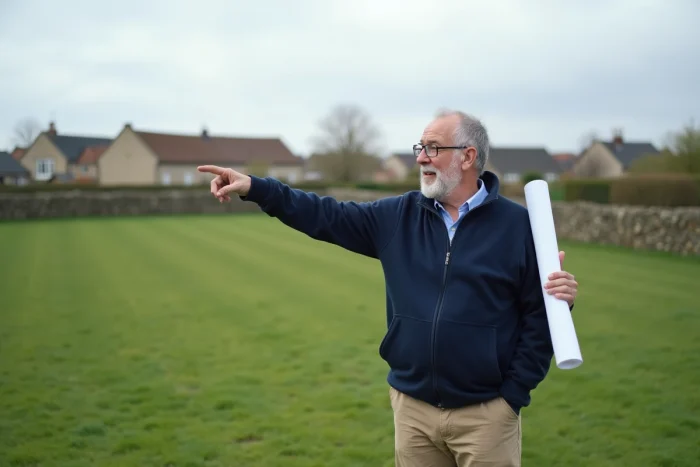
A communal plot is a parcel belonging to the private domain of a municipality. Its transfer or availability is subject to rules distinct from those of a transaction between individuals: the community must justify the operation with a resolution from the municipal council and demonstrate a local interest. Understanding this legal framework before submitting any request avoids months of unnecessary procedures.
Municipal Council Resolution: The Legal Lock on Communal Land
The municipality does not sell land like a private owner. Any transfer of a property from the communal private domain requires an explicit resolution from the municipal council, accompanied by a justification that establishes the community’s interest in parting with the parcel.
This resolution addresses several points: the cadastral identification of the land, the price determined after assessment by the Domain Services (France Domaine), and the justification of the operation in light of the communal interest. Without this justification, the sale can be annulled by the administrative court.
To fully understand the procedures for a communal plot, it is important to remember that the initiative always comes from the community, even when an individual makes the request. The town hall processes the file, consults the relevant services, and then submits the project for a vote by the council.
A point often overlooked: the mayor cannot decide alone. Even with a verbal agreement in principle, nothing binds the municipality until the resolution has been adopted and transmitted for legality control to the prefecture.

Buildability and Urban Planning Rules Applicable to the Land
Obtaining the transfer does not guarantee the right to build. The Local Urban Plan (PLU) sets the rules for land development and use in the municipality. For small municipalities without a PLU, the communal map defines the buildable areas.
Before any commitment, two documents should be requested from the town hall:
- The information urban planning certificate, which provides information on the applicable rules for the parcel, taxes, and existing easements. It can be requested by any interested party, not just the owner.
- The operational urban planning certificate, which indicates whether a specific construction project is feasible on the land. This document is more binding and requires a description of the proposed operation.
- The report on public utility easements, which may reveal constraints related to passage, view, or networks on the parcel.
The urban planning certificate is not a building permit. It crystallizes the applicable rules for a limited duration, protecting the buyer against a change in zoning between the promise and the signing of the deed.
Land Use Efficiency and Soil Artificialization
Compatibility with the objectives of reducing soil artificialization has become a criterion of vigilance. Communal urban planning documents are now assessed in light of the land use efficiency trajectory stemming from the Climate and Resilience Law. A communal plot located on the edge of urbanization or in urban expansion may face a refusal of buildability for this reason.
Therefore, verifying buildability can no longer be limited to reading the PLU. The project must also comply with the land use efficiency rules that increasingly govern extensions in peri-urban areas.
Price Estimation and Notary Involvement
The municipality is required to have the land appraised by France Domaine before any transfer. This appraisal sets a minimum price: selling below this would expose the community to reclassification as a gift, meaning an unjustified financial advantage to the buyer.
The price retained in the resolution can be higher than the appraisal, but never lower without solid justification. The buyer does not have access to the appraisal report, but they can request to know the retained value before committing.
Signing the Sales Deed
The sale is formalized by a notarized deed drafted by a notary. The notary verifies the regularity of the resolution, the absence of mortgages on the parcel, and the cadastral compliance. Notary fees are borne by the buyer, as with any real estate transaction.
A preliminary contract (compromise or promise of sale) may precede the final deed. This step is recommended when the buyer needs time to obtain financing or a building permit.

Servicing and Connection of the Communal Land
A communal plot is not always serviced. Before signing, it is essential to check for the presence or absence of connections to water, electricity, sanitation, and telecommunications networks.
If the land is not serviced, the servicing works can represent a significant cost, varying according to the distance to existing networks. The municipality may sometimes cover part of the network extension if the transfer is part of a local development project, but this is not automatic.
Requesting a connection quote from the service providers before signing allows for estimating the actual budget of the project. Water, electricity, and sanitation each depend on a different operator or union, with varying connection times.
Soil Study and Environmental Risks
For land intended for construction, a geotechnical study (soil study) provides information on the nature of the subsoil and suitable foundations. Environmental risks (flooding, shrink-swell of clays, pollution) are included in the state of risks and pollution, a mandatory document attached to any preliminary sales contract.
The town hall provides information on identified natural and technological risks in the communal territory. Consulting these documents before making an offer helps avoid discovering a prohibitive constraint after commitment.
The acquisition of a communal plot follows a more regulated administrative process than a standard purchase, but each step serves a specific protective function, both for the municipality and the buyer. The starting point remains the same: make an appointment at the town hall to verify if the targeted parcel can be transferred and under what conditions the municipal council would agree to deliberate.