The water in your pool seems cloudy, the chlorine is losing effectiveness, and a whitish deposit is appearing on the walls. These symptoms often point to a TAC that is too high, meaning an alkalinity that exceeds the comfort zone of the pool. Correcting this imbalance does not require draining the pool, but it does involve understanding why the TAC is rising and how to bring it back to a stable level without creating other problems.
TAC and pH: why correct alkalinity before everything else
Have you noticed that your pH keeps rising despite your adjustments? The TAC is often the direct cause. Alkalinity acts as a buffer: it slows down pH fluctuations.
When this buffer is too strong, the pH gets stuck at a high level. Adding pH- under these conditions is like trying to empty the ocean with a spoon. As long as the TAC remains too high, the pH will not stabilize sustainably.
This is why pool professionals recommend always correcting the TAC before touching the pH. The order matters. If you already know what to do in case of high pool alkalinity, you understand this logic: restore the buffer first, then adjust the pH.
Salt electrolyzer and multifunction tablets: two modern causes of high alkalinity
Pool forums often point to hard fill water or an overdose of baking soda. This is true, but two more recent sources regularly go unnoticed.
Automatic salt treatment systems
In recent years, owners equipped with salt electrolyzers have noticed slow increases in TAC. The problem stems from a blind spot in monitoring: these systems control chlorine and sometimes pH, but TAC is almost never monitored automatically. In a pool with low water renewal, alkalinity gradually rises without triggering any alerts.
Stabilized multifunction tablets
Tablets that combine stabilizer, flocculant, and algaecide complicate matters. Abruptly correcting TAC with a strong acid in a pool treated with these products increases the risk of over-stabilization. Cyanuric acid rises, and chlorine loses its disinfecting power.
Any correction of alkalinity in a pool treated with multifunction tablets must be spread over several days. A single-day adjustment, sometimes referred to as “acid shock,” creates more problems than it solves.
Lowering pool TAC: muriatic acid, bisulfate, or aeration
Three approaches can help lower excessively high alkalinity. Each has its context of use and limitations.
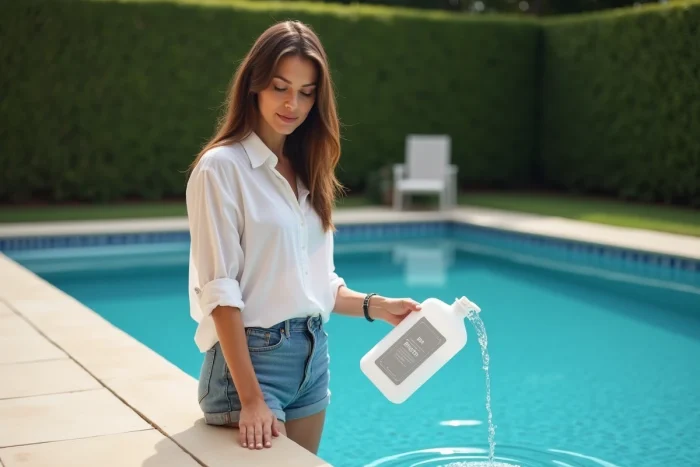
- Muriatic acid (diluted hydrochloric acid): the most powerful for quickly lowering TAC. It is added directly to the pool, with the filtration running, by pouring it in front of a return jet. Caution dictates never exceeding a small dose per intervention and retesting after a few hours of circulation.
- Sodium bisulfate (pH-): easier to dose and less aggressive on equipment. It acts on both TAC and pH simultaneously. Suitable for moderate corrections, it remains the most common choice for homeowners.
- Forced aeration of the water: directing return jets towards the surface, activating counter-current swim jets, or running a waterfall for several hours helps to degas dissolved CO2. This technique gradually lowers TAC without adding chemical products. It is particularly suitable for pools equipped with spa features or waterfalls.
Aeration alone is rarely sufficient when TAC significantly exceeds the comfort zone. However, combining aeration with small doses of acid remains the safest method to avoid a sudden drop in pH.
TAC testing frequency: the trap of monthly measurement
Why do some owners discover a very high TAC when everything seemed normal the previous week? Because they test too infrequently.
Maintenance guides updated in recent years recommend measuring TAC at least once a week, rather than once a month as was often the case before. The reason is simple: between city water inputs, summer evaporation, and the use of treatment products, TAC can vary significantly in just a few days.
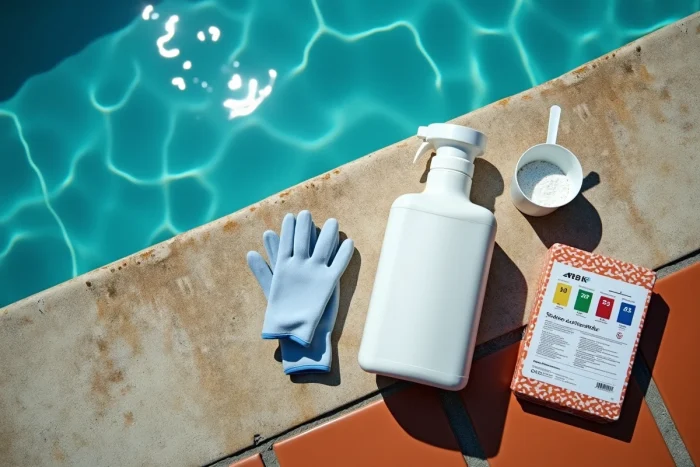
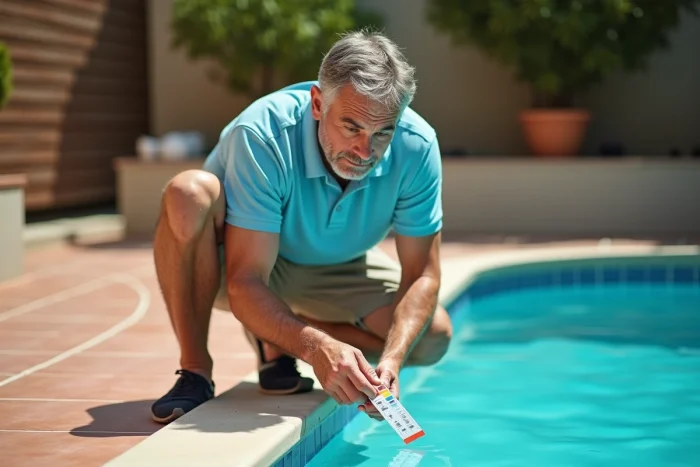
Standard test strips provide an indication, but their accuracy remains limited. A colorimetric test kit with liquid reagent offers a more reliable reading of TAC. Connected probes, increasingly common, automate this monitoring and send an alert when TAC falls outside the acceptable range.
When to test as a priority
Three situations justify an immediate TAC test:
- After a storm or heavy rain, as rainwater alters the chemical composition of the pool.
- After a significant input of new water (partial filling, compensation for prolonged evaporation).
- As soon as the pH becomes difficult to stabilize despite regular additions of corrector.
Pool TAC correction: the schedule that avoids mistakes
Lowering alkalinity is not a one-time operation. It is a gradual adjustment that spans several days, sometimes a full week.
On the first day, add a moderate dose of acid (muriatic or bisulfate) and let the filtration run for several hours. Test the TAC and pH the next morning, before any new intervention. If the TAC remains above the desired range, repeat the operation with the same dose.
Never double the dose to speed up correction. An overdose of acid can drop the pH below the safety threshold, damage the liner or seals, and make the water irritating to the skin and eyes.
In parallel, activate aeration (oriented jets, waterfall, jets) for a few hours each day. This gradual combination allows you to bring TAC back into the proper range without causing a yo-yo effect on pH.
A pool with stable TAC makes all other maintenance easier: chlorine works better, pH fluctuates less, and the walls remain clean. Monitoring this parameter weekly, correcting with small adjustments, and avoiding drastic treatments is ultimately the most economical and reliable method for keeping swimming water healthy.