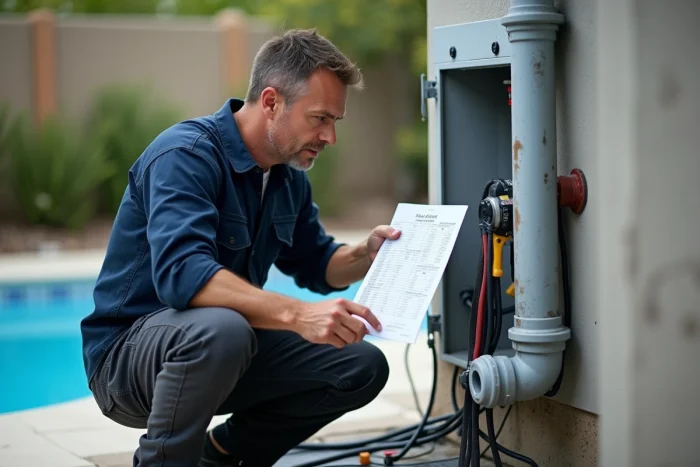
The sizing of the cable that connects the electrical panel to the pool pump relies on a calculation that many guides oversimplify. The NF C 15-100 standard, in its recent amendments, requires considering several parameters to obtain a reliable cross-section: operating current, line length, installation method, and ambient temperature of the technical room or trench.
Correction factors and ambient temperature: what standard tables overlook
Most available content provides a table associating pump power and cable cross-section, without mentioning the corrections related to actual installation conditions. The UTE C 15-105 guides (consolidated versions 2022-2023) emphasize two determining factors.
The first is the type of cable installation: a cable buried directly in the ground, a cable run in ICTA conduit in a trench, and a cable run exposed in a technical room do not dissipate heat in the same way. The permissible current for the same cross-section varies significantly depending on the case.
The second factor is ambient temperature. A technical room in full sun, without ventilation, can far exceed the reference of 30 °C on which standard tables are based. Each additional degree reduces the cable’s ability to dissipate heat, and thus the current it can support without excessive heating. A properly sized cable in a cool basement may prove undersized in a technical box exposed to the south.
To choose the cable cross-section for pool power supply reliably, it is therefore necessary to apply these correction factors to the nominal current of the pump before consulting a correspondence table.
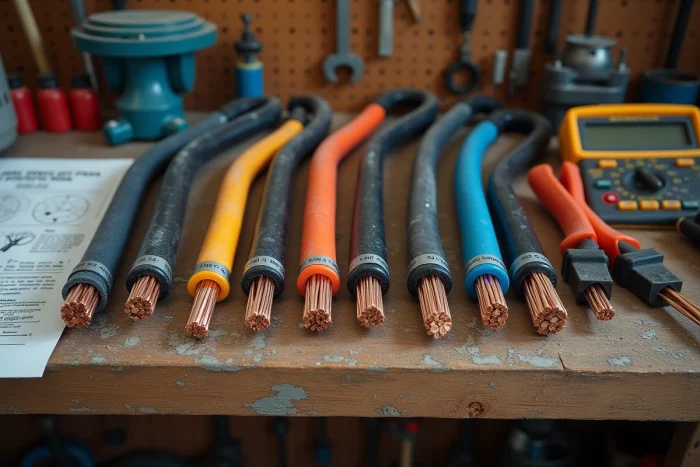
Variable speed pump or fixed speed: the impact on cable cross-section
Variable speed pumps have become predominant in new pool installations. Their operation directly modifies the cross-section calculation, and not just for energy-saving reasons.
A classic fixed-speed pump generates a high starting current, often several times higher than the nominal current. This peak puts stress on the cable and protections for a few seconds. The voltage drop at startup must remain below the recommended threshold for motor circuits, which sometimes leads to oversizing the cross-section.
With a variable speed pump, the integrated inverter smooths the power ramp-up. The starting current is significantly lower, which reduces the strain on the line. Technical documentation from manufacturers like Pentair or Hayward indicates that this feature sometimes allows for maintaining a smaller cross-section for the same distance, while staying within normative limits.
Before determining the cross-section, check the type of pump installed or planned. The savings can be significant: over a line of several dozen meters, the difference in cross-section between a fixed pump and a variable pump can represent a notable cost difference in the cable.
Voltage drop and cable length: the calculation that many overlook
The distance between the electrical panel (or dedicated protection box) and the pump is the parameter that sways the choice of cross-section. For motor circuits, the voltage drop should not exceed 3% during normal operation.
On a short line, this issue rarely arises: standard cross-sections are sufficient. However, as soon as the pump is more than twenty meters from the panel, the resistance of the cable begins to weigh in. The energy lost as heat in the conductor reduces the voltage available at the motor terminals, which can cause:
- A decrease in pump performance, which runs without reaching its nominal flow rate.
- An overheating of the motor, which compensates for the undervoltage by drawing more current.
- An unexpected tripping of the protection circuit breaker, especially at the startup of a fixed-speed pump.
The calculation of the voltage drop relies on the classic formula incorporating the resistivity of copper (or aluminum, which is rarer in residential settings), the round-trip length of the cable, the operating current, and the conductor cross-section. In case of doubt, increasing the cross-section by one notch compared to the theoretical result provides a reasonable safety margin.
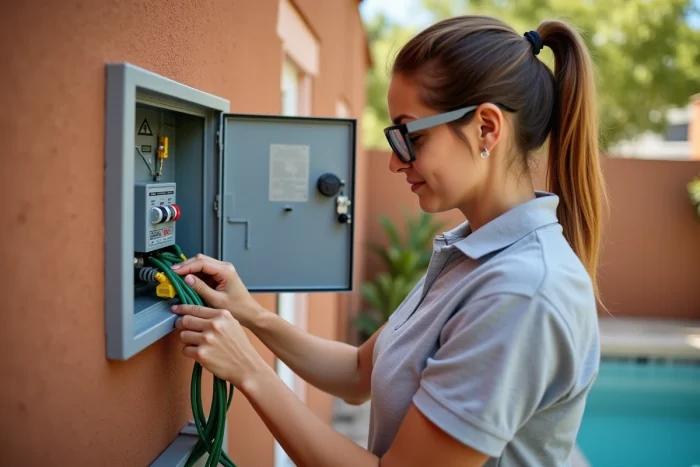
Protection and grounding of the pool pump circuit
The sizing of the cable is not limited to choosing the cross-section of the active conductors. The NF C 15-100 standard requires a dedicated circuit for the pump, protected by a 30 mA residual current circuit breaker. This device cuts off the power supply in case of current leakage, an essential precaution in an environment where water is omnipresent.
The earth conductor must accompany the active conductors in the same conduit or multi-conductor cable. Its cross-section follows that of the phase conductors, according to usual rules. A cable of type R2V (or its equivalent for buried installation) with an integrated earth conductor simplifies installation and limits connection errors.
Points to check before powering up:
- The dedicated circuit breaker is calibrated according to the nominal current of the pump, not the cable cross-section.
- The local equipotential bonding connects all accessible metal masses around the pool (ladder, metal coping, technical room).
- The buried cable is laid at a compliant depth (generally at least 50 cm underground, with warning mesh) and mechanically protected if necessary.
Flexible or rigid cable for the technical room
In the technical room itself, a flexible cable (type H07RN-F) facilitates connection, especially if space is tight. For the buried or outdoor part, a rigid cable of type R2V offers better mechanical strength. Mixing the two types on the same circuit is common, provided that the junctions are made in watertight junction boxes (minimum IP55).
The choice of cable cross-section for a pool pump is not just about reading a line in a table. The temperature of the room, the installation method, the actual distance between the panel and the pump, and the type of motor (fixed or variable) all modify the result. Taking the time to calculate rather than estimate avoids costly malfunctions and, above all, electrical risks in a humid environment.