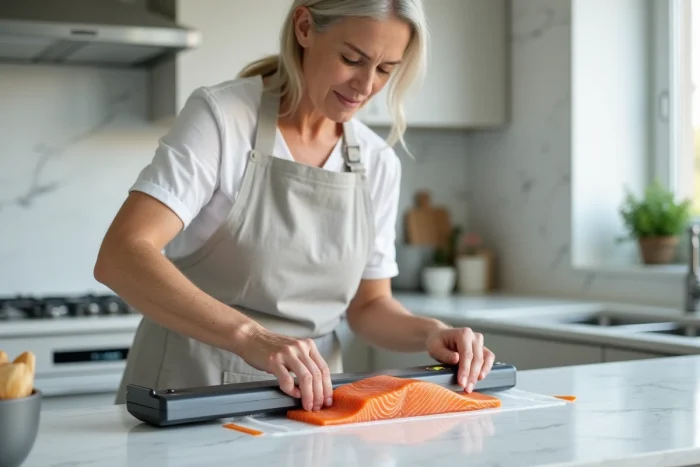
Fresh fish loses its organoleptic qualities in just a few hours once removed from ice. Vacuum sealing slows this degradation by eliminating contact with oxygen, but this technique does not guarantee absolute food safety.
ANSES and EFSA warn about a specific risk: Clostridium botulinum type E, a bacterium found in marine environments, capable of developing at low temperatures in an oxygen-poor environment. Mastering the preservation of vacuum-sealed fish at home requires understanding this risk and applying rigorous technical practices.
Clostridium botulinum type E: the invisible danger of vacuum-sealed fish in the refrigerator
Vacuum sealing creates an anaerobic environment. For most foods, this is an advantage: molds and aerobic bacteria can no longer proliferate. Raw fish is an exception.
Clostridium botulinum type E is distinguished from other strains by its ability to produce toxins at refrigeration temperatures. A vacuum-sealed fillet of cod or salmon may appear flawless (color, smell, texture) while harboring active contamination. EFSA’s recommendations, updated in 2022, emphasize one point: vacuum sealing alone is not sufficient for refrigerated raw fish.
The preservation of fresh fish under vacuum in the refrigerator should therefore be limited to a few days, no more. Beyond that, even if the fish appears consumable, the risk of botulinum toxin significantly increases.
Multiple safety barriers: the professional method adapted for home use
Industrial operators selling vacuum-sealed fish in large distribution are required, according to EFSA recommendations, to combine vacuum sealing with at least one other safety barrier. This so-called “multiple barriers” approach can be applied in a home kitchen.
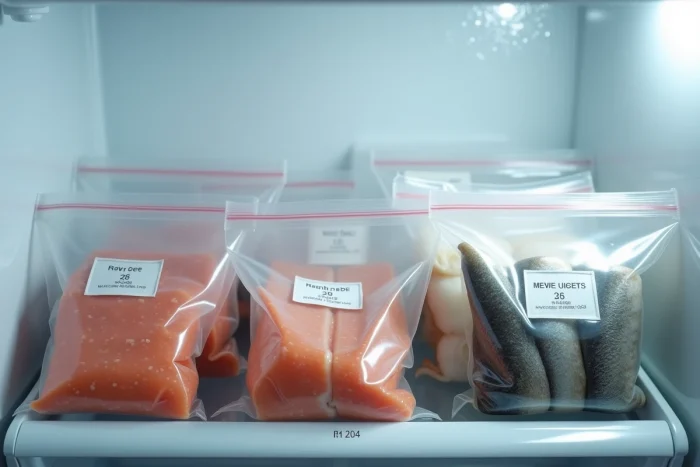
Three accessible barriers at home deserve to be detailed:
- Rapid freezing after vacuum sealing. This is the most reliable solution for long-term preservation. Freezing immediately after vacuum packaging halts bacterial development, including that of Clostridium botulinum type E. The fish retains its taste and nutritional qualities much longer than with conventional freezing, as the vacuum bag prevents the formation of ice crystals and freezer burn.
- Light salting before packaging. A moderate pre-salting (a few minutes in a fine salt mixture) lowers the water activity on the surface of the fillet. This additional barrier limits the growth of anaerobic bacteria during the refrigeration phase.
- Spot acidification. A fish fillet brushed with lemon juice or mild vinegar before vacuum sealing sees its surface pH decrease, which slows bacterial multiplication. This technique is particularly suitable for white fish intended to be consumed raw or lightly cooked.
Combining two of these barriers with vacuum sealing offers a level of safety close to that of professional products. The combination of vacuum sealing and freezing remains the safest option for preservation beyond a few days.
Preparing fish before vacuum sealing: technical gestures that change the outcome
The effectiveness of vacuum sealing depends as much on the preparation of the fish as on the machine used. A poorly prepared fillet, even perfectly packaged, will degrade faster.
Empty and rinse the fish in cold water as soon as you return from the market. The goal is to eliminate residual blood and viscera, two major sources of bacterial proliferation. Then dry each piece with paper towels. Residual moisture on the surface of the fillet promotes microbial development, even under vacuum.
For whole fish, remove the gills before packaging. The gills concentrate a high bacterial load and accelerate degradation, even in an anaerobic environment.
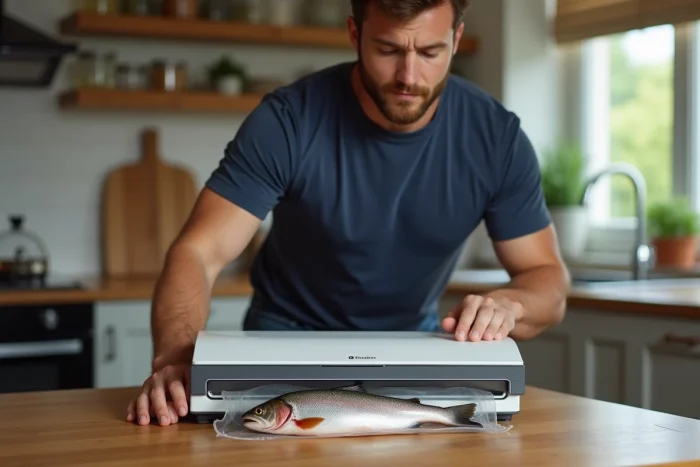
The fish juice (exudate) that accumulates at the bottom of the bag during refrigeration creates an environment conducive to bacteria. Two solutions exist: place a sheet of absorbent food paper at the bottom of the bag before placing the fillet in, or freeze the fish flat for about twenty minutes before starting the vacuum sealing cycle.
This short pre-freezing stiffens the surface and reduces the amount of liquid sucked in during sealing.
Choosing the bag and machine settings for vacuum sealing fish
Not all vacuum bags are suitable for seafood. Embossed (or textured) bags are the most common on home vacuum machines with external suction. Their channel texture allows for effective air extraction, but their thickness varies by manufacturer.
A bag that is too thin risks being punctured by a bone or fin, which negates the purpose of the process. For fish, prefer bags of sufficient thickness, and wrap protruding bones in a piece of food paper before sealing.
Regarding settings, most home machines offer a “liquid” or “gentle” mode. This mode reduces suction power at the end of the cycle to avoid crushing the fillet or sucking the exudate into the sealing mechanism. An excess of liquid in the sealing area produces a faulty seal, which compromises the entire preservation.
If your machine does not have this setting, start the sealing process manually as soon as you notice that the air has been removed but before the liquid reaches the sealing bar. This manual intervention requires a bit of practice, but it makes the difference between a watertight package and a bag that will reopen in the freezer.
Realistic shelf life of vacuum-sealed fish: refrigerator vs. freezer
The shelf life stated on some websites lacks caution. In the refrigerator, vacuum-sealed raw fish should not be stored for more than a few days, according to ANSES recommendations. The absence of a suspicious odor does not guarantee the absence of toxins: Clostridium botulinum produces odorless and colorless toxins.
In the freezer, the situation changes dramatically. Vacuum sealing multiplies the storage duration compared to conventional freezing in a zip bag or aluminum foil. Vitamins and minerals are better preserved, and the texture remains close to that of fresh fish after thawing.
The thawing process itself deserves attention. Remove the vacuum-sealed fish from the freezer and place it in the refrigerator the day before. Never thaw vacuum-sealed fish at room temperature: the temperature rise in an anaerobic environment recreates conditions favorable to Clostridium botulinum. Once the bag is opened, consume the fish within hours.
Vacuum sealing fish at home is an effective preservation tool, provided it is never considered a standalone solution. Immediate freezing after packaging, pre-salting, or acidification are complementary barriers that transform a risky technique into a reliable method. The most protective gesture remains the simplest: in case of doubt about the duration or temperature of storage, do not consume the fish, even if it looks perfect.