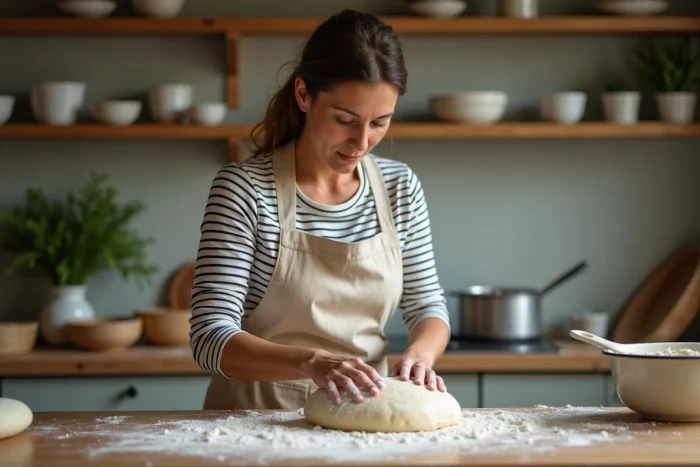
What criteria allow us to distinguish a truly practical family recipe from a recipe that looks appealing on paper but is time-consuming in practice? Preparation time, number of ingredients, adaptability to children’s tastes, and cost per serving form a useful framework for sorting delicious recipes that work on a daily basis.
Preparation time and number of ingredients: comparing family recipe formats
Recipes intended for the whole family are not equal in terms of actual effort. Two dishes labeled as “easy” can require very different investments depending on the number of steps, the equipment needed, and the total time from the start of preparation to when the dish is served.
| Type of recipe | Estimated preparation | Common ingredients | Child adaptability |
|---|---|---|---|
| Savory tart (zucchini, cheese) | Short (store-bought crust) | 4 to 6 | High |
| Vegetable gratin | Medium (chopping + oven cooking) | 5 to 8 | High |
| Complete composed salad | Short (assembly) | 6 to 10 | Variable depending on vegetables |
| Stew (like a casserole) | Long (slow cooking) | 7 to 12 | High after cooking |
| Batch cooking (weekly preparation) | Long (single session) | 15 to 20 in total | High throughout the week |
The savory tart and gratin stand out with a particularly favorable effort/satisfaction ratio. With a crust base, a few seasonal vegetables, and cheese, the result pleases both children and adults without requiring more than half an hour of active work.
Composed salads require little cooking, but chopping multiple ingredients extends the preparation time. The stew, on the other hand, demands patience: slow cooking transforms ordinary pieces into a tasty meal, provided one accepts the waiting time.
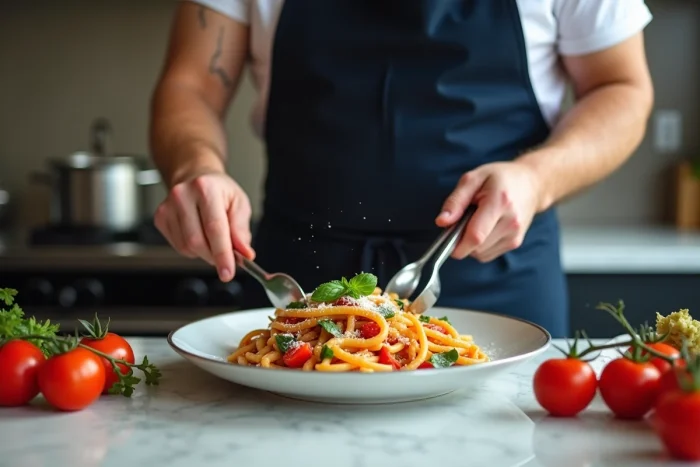
Family batch cooking: a method that changes meal management during the week
In recent years, research on family batch cooking has significantly progressed on French search engines, with a recurring peak at the beginning of the school year. This method involves dedicating a single cooking session (on Sunday, for example) to preparing several meals for the week.
The interest lies not in the individual recipe but in the strategic assembly. You can find delicious recipes adapted to this format on the À Nos Petits Fourneaux website, where preparations are designed to combine and reheat easily.
Batch cooking is based on a few concrete principles:
- Choose a base of starches (rice, pasta, potatoes) that can be transformed into several meals with different sauces or sides
- Prepare two or three vegetables in large quantities (roasted zucchini, glazed carrots, green beans) to vary the plates without having to cook each night
- Cook a versatile protein (roast chicken, hard-boiled eggs, lentils) that can be used cold in salads or reheated as a main dish
The time savings focus on weekday evenings, when energy is low. Assembling a meal from pre-cooked elements rarely takes more than fifteen minutes.
However, the initial session requires organization. Without a precise shopping list and meal plan, there is a risk of wasting ingredients or producing dishes that are too similar.
Cooking with children: a concrete lever for vegetable acceptance
The National Nutrition Health Program (PNNS 4, updated by Public Health France in 2024) explicitly recommends children’s participation in meal preparation as a way to improve their acceptance of vegetables and reduce snacking. Washing, simple chopping, and seasoning are among the suggested tasks.
This point is rarely addressed in classic family recipe pages, which focus on the result on the plate rather than the preparation process. Yet this angle is crucial: a child who has washed the zucchinis and grated the cheese is more likely to enjoy the tart they helped prepare.
Some recipes lend themselves better than others to this approach:
- Tarts and quiches, where the child can roll out the dough, arrange the vegetables, and pour the filling
- Composed salads, which allow for ingredient selection like a building game
- Simple cakes (like savory or sweet cakes), where weighing and mixing develop motor skills
- Wraps or filled flatbreads, which each family member can personalize according to their tastes
Adapting the recipe to the child’s age is key to the success of the exercise. Before six years old, tasks without knives or heat sources are the most suitable. Beyond that, chopping soft vegetables (zucchini, mushrooms) under supervision gradually introduces autonomy.

Digital tools and family meal planning: a rapidly growing usage
French households have significantly increased their use of apps and websites to plan family meals. According to a Médiamétrie study for Fevad published in October 2024, the growth of meal planning apps is notable, driven by the search for savings and the reduction of food waste.
This trend is changing how families approach cooking on a daily basis. Rather than searching for a recipe at the last minute, weekly planning allows for grouping purchases, limiting duplicates, and ensuring that each meal includes vegetables, starches, and a source of protein.
The digital tool does not replace the joy of cooking but structures the logistics. For a family of four, planning five dinners in advance reduces impulsive purchases and simplifies the shopping list. Batch cooking naturally fits into this framework, as the weekend session directly stems from the planned menu.
The intersection of digital planning, batch cooking, and children’s involvement creates a mode of operation where family cooking gains regularity without sacrificing variety. The most sustainable delicious recipes in a weekly rotation are those that combine reasonable preparation time, accessible ingredients, and a margin for adaptation to everyone’s preferences.