The extended family is not just summarized by a large family tree. It is an organized system where the transmission of values, memory, and heritage follows precise mechanisms, often codified over several generations. Understanding this universe requires examining the gears that maintain cohesion among descendants dispersed geographically and socially.
Family Governance and Written Charters: The Framework Ignored by Popular Articles
The rise of French family governance structures marks a structural turning point. Inspired by Anglo-Saxon family offices, these practices have significantly developed after the health crisis. We observe that large families are now formalizing their internal rules through written family charters, which serve as true private constitutions.
These charters cover concrete subjects: rules for intergenerational donations, collective funding of education, shared ecological commitments, common patronage. The Superior Council of Notaries supports this structuring alongside specialized heritage firms.
The principle is based on formalized annual meetings, sometimes called “family councils,” which far exceed the legal framework of family councils as provided by the Civil Code for minors under guardianship. Here, it involves voluntary bodies where each branch sends a representative. Some families that document their history and practices share their feedback on the homepage of Famille XH, allowing for an assessment of the diversity of approaches adopted.
- Drafting a charter specifying the founding values, mutual obligations, and voting procedures on heritage decisions
- Establishing a meeting calendar (annual or semi-annual) with an agenda sent in advance to each branch
- Designating a “family secretary” responsible for maintaining archives, writing minutes, and ensuring continuity between generations
Transmission of the Family Name: What the 2022 Law Changes
Law No. 2022-301 of March 2, 2022, regarding the choice of name stemming from parentage has profoundly reconfigured the notion of lineage. Since July 1, 2022, parents can freely choose the order and combination of names (father’s name, mother’s name, or both). A simplified name change is now possible in adulthood.
For large families attached to a historical surname, this reform raises operational questions. When the “house name” carries a coat of arms, a domain, or a business, its dilution in a double naming redistributes the symbolic cards. Notaries note that this necessitates rethinking symbolic transmission well beyond mere civil status.
We recommend that concerned families integrate this question into their charter. Specifying the place of the historical name in collective identity, without legally constraining individual choices, requires a delicate balance. The name is no longer an automatic inheritance but an active choice, which alters the relationship to parentage.
Family Memory and Writing Practices: Going Beyond the Photo Album
The sociology of family memory distinguishes two registers: living memory (oral narratives, anecdotes shared during meals) and archived memory (documents, family books, correspondence). Enduring large families cultivate both simultaneously.
The Family Book as a Cohesion Tool
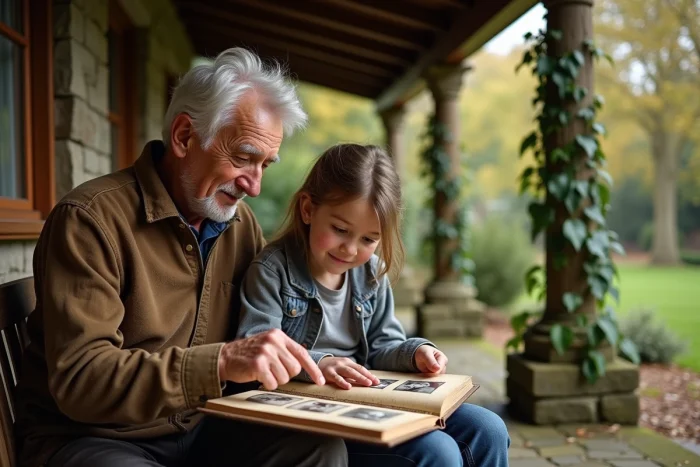
The family book is not limited to the civil status booklet. In the tradition of structured families, it takes the form of a collection of memories, stories, and genealogical references updated by each generation. This material support anchors memory in a transmittable object, unlike digital files scattered across cloud services whose longevity remains uncertain.
Writing this book involves collecting stories from the elders. Family stories do not spontaneously emerge: they require structured interviews conducted before the memories of the oldest fade.
Memories and Objects Charged with Meaning
Beyond writing, objects play a role as identity markers. A watch, a piece of furniture, a work tool passed down through generations crystallizes a story that words alone cannot convey. Documenting the provenance of each transmitted object (date, context, associated anecdote) transforms material heritage into a memory support.

Family Traditions and Rituals: What Structures the Collective Life of Descendants
Family traditions are not decreed. They emerge from repeated practices that eventually acquire symbolic value. Sociology distinguishes calendar rituals (annual celebrations, collective anniversaries, summer gatherings) from rites of passage (births, marriages, entries into working life).
What differentiates a large family from a simple kinship network is the formalization of these rituals. When a Christmas meal follows a protocol passed down for several decades (seating arrangement, menu, speaking order), it produces a sense of belonging that informal gatherings do not generate.
Parents and children participating in these rituals do not always perceive their structuring function at the moment. It is often in the next generation that the absence is felt when an abandoned tradition leaves a void in the family calendar.
- Writing down the main ritual procedures so that an absent member can resume them without disruption
- Involving children in the organization from adolescence, which accelerates their appropriation of family codes
- Accepting the evolution of practices: a tradition that does not adapt to current lifestyles disappears within a generation
The life of a large family relies on a balance between what remains fixed and what renews. Charters, memory books, and rituals do not freeze history: they create a framework strong enough for each generation to inscribe its own page.