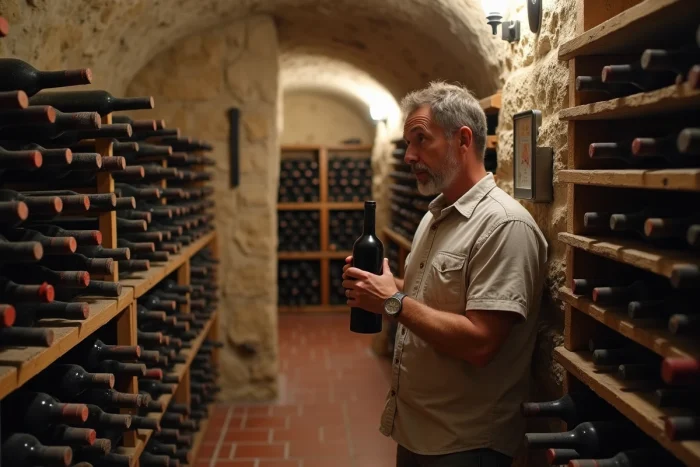
The repeated temperature of 10 to 14 °C everywhere is not enough to guarantee proper aging. What really determines the evolution of wine in a cellar is the combination of the average thermal level and the amplitude of variations around that level. We will detail the technical parameters that general public guides overlook.
Thermal Inertia of the Cellar and Seasonal Gradient
A cellar buried two meters below ground level naturally has high thermal inertia. The temperature fluctuates by a few degrees throughout the year, with a delay of several weeks compared to external variations. This delay is the true advantage of a natural cellar.
The problem arises when the seasonal amplitude exceeds a few degrees. Slow and regular variations are tolerable, but sudden jolts are not. A gradual shift from 11 to 15 °C between January and August over six months does not harm the wine. In contrast, a difference of a few degrees in a few hours, caused by a poorly insulated door or a nearby heating system, generates micro-expansions of the cork that promote premature oxidation.
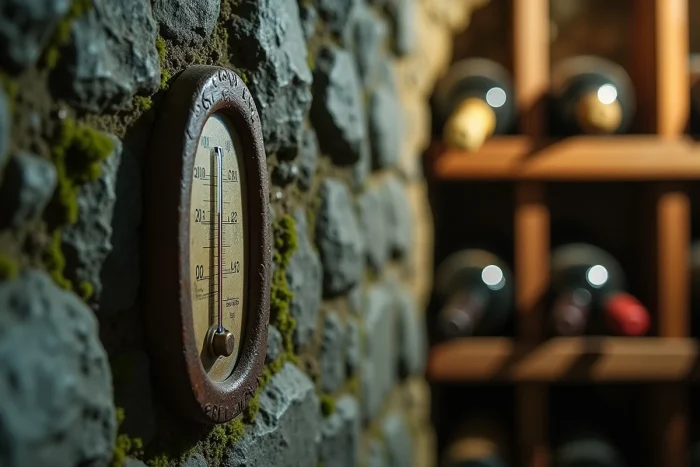
We recommend placing a temperature logger for a complete annual cycle before any investment in bottles. Knowing the actual curve of your cellar allows you to determine if a regulation system is necessary, and which type to choose. It is by mastering the ideal wine cellar temperature to maintain that one avoids costly corrections afterward.
Wine Storage Temperature: Target Zone and Real Tolerance
The optimal storage temperature is around 12 °C, with an accepted tolerance between 10 and 14 °C. This consensus is based on the kinetics of the evolution of phenolic compounds: below 10 °C, chemical reactions slow down to the point of freezing aromatic evolution. Above 14 °C, aging accelerates and the wine loses complexity.
What is important to remember is that this range concerns aging, not serving. A single-temperature aging cellar set at 12 °C is not suitable for directly serving a white or sparkling wine. Confusing storage temperature with tasting temperature remains the most common mistake.
Aging versus Serving: Two Distinct Logics
Long-term storage requires a unique and stable temperature. Serving, on the other hand, requires a temperature suited to each type of wine. Full-bodied reds are served warmer than dry whites, which are themselves served cooler than sparkling wines.
- Red wines for aging are stored at 12 °C but are generally served a few degrees higher, depending on their tannic structure.
- White and rosé wines are stored at the same cellar temperature but require a stint in the refrigerator or a service cellar set lower before tasting.
- Champagne and sparkling wines can withstand the same storage range as other wines, but their serving temperature is the lowest, well below the storage temperature.
Storing all wines at 12 °C and adjusting at the time of serving remains the most reliable method. Multi-temperature cellars are useful for serving, not for storage.
Hygrometry and Interactions with Temperature in Wine Cellars
Temperature does not operate in isolation. The hygrometry of the cellar directly interacts with the preservation of the cork, and therefore with the bottle’s seal.
A humidity level between 60 and 80% protects the cork from drying out. Below 50%, the cork shrinks and allows air to pass through. Above 80%, mold develops on labels and racks, without affecting the wine itself as long as the cork remains healthy.
The link with temperature is direct: a cellar that is too cold with excessive ventilation dries out the air. Conversely, a cellar that is too warm without renewal encourages condensation and fungal problems. The balance is found in slow and regular air circulation, without direct drafts on the bottles.
Vibrations and Light: Often Overlooked Aggravating Factors
Vibrations disturb the natural deposit that forms in aging wines. A poorly damped electric cellar compressor, an adjacent technical room, or frequent passage can be enough to keep particles suspended and ultimately alter the clarity of the wine.
Light, especially UV, degrades the organic compounds in wine. Clear glass bottles are the most vulnerable, but even tinted glass does not filter the entire spectrum. A cellar without permanent lighting, with a timer switch, solves the problem at a lower cost.
Natural Cellar or Electric Cellar: What Impact on Thermal Stability
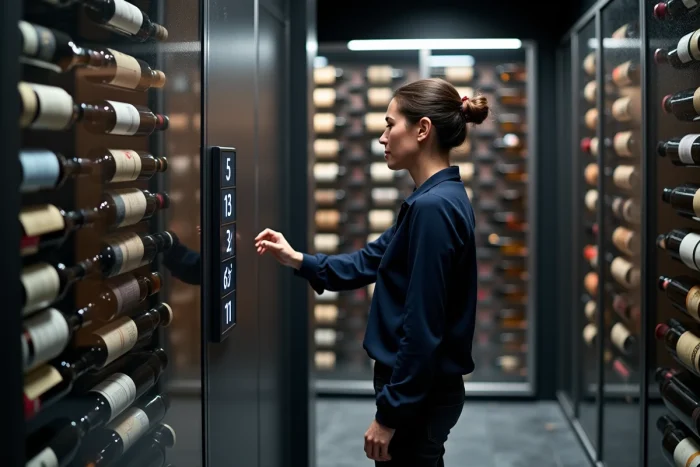
A buried cellar with stone or raw concrete walls offers passive regulation that electric cellars attempt to mechanically reproduce. We observe that well-designed natural cellars maintain thermal stability superior to that of most entry-level electric cabinets, whose compressor cycles create slight oscillations.
High-end electric cellars compensate for this flaw with finer regulation systems, featuring multiple probes and variable-speed compressors. For aging use over several years, the selection criterion remains the consistency of the temperature measured over a complete week, not the value displayed on the thermostat.
- Check the gap between the displayed temperature and the actual temperature measured at the center of the cellar (a deviation of a few degrees is common in low-end models).
- Prefer models with reinforced insulation and solid doors rather than glass, as glass is a thermal weak point.
- Position the electric cellar in a room where the ambient temperature remains moderate year-round, to limit the compressor’s workload.
The electricity consumption of a cellar increases significantly when it compensates for an environment that is too warm. Placing a wine cabinet in a south-facing garage in summer means running the compressor continuously, impacting both the bill and the longevity of the device.
The choice between a natural cellar and an electric cellar primarily depends on the existing structure. A semi-buried basement with good thermal inertia often only requires a hygrometer and a temperature logger to validate its performance. The investment in an electric cabinet is justified when no space in the home naturally drops below the stable threshold of 14 °C.