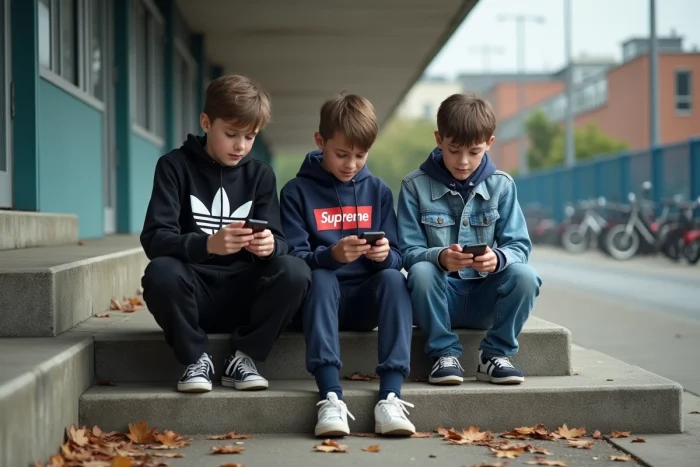
In a middle school courtyard in the suburbs of Lyon, a teenager is wearing a sweatshirt from a brand discovered on TikTok three weeks earlier. His neighbor sports a Nike hoodie bought on Vinted, resold by a Parisian high school student. The third has customized a basic Décathlon piece with homemade printing. Three styles, three budgets, three relationships with brands. Discussing teens’ favorite brands without considering where they buy and how much they spend misses the point.
Budget, neighborhood, and resale: what really influences a teen’s brand choice
You don’t choose a brand the same way with a twenty-euro monthly budget as you do with a hundred. For many teenagers, financial constraints filter preferences well before personal taste. A middle school student who wants to wear Nike or Stüssy without the corresponding budget turns to second-hand, where availability depends on local supply on resale platforms.
This circuit creates a concrete phenomenon: some teens buy with resale in mind. A pair of limited edition sneakers is not just a purchase; it’s an investment. The goal is to wear them for a few months and then resell them to fund the next pair. This circular reflex changes the very nature of brand preference, which becomes a calculation of depreciation.
Geographical disparities also exist. In suburban areas, global sportswear brands (Nike, Adidas, Puma) dominate, driven by their availability in supermarkets and stable resale value. In affluent urban centers, there is a rise of more discreet labels, often eco-friendly or minimalist, that circulate within smaller circles. The postal code influences preferences as much as the TikTok feed.
To better understand the trendy brands among teens analyzed from this socio-economic angle, it is essential to cross taste statements with actual purchasing behaviors, which are often very different.
Micro-brands and DNVBs: teen loyalty is built on TikTok, not in stores
Major brands remain visible, but an increasing share of teenage preferences leans towards micro-brands discovered exclusively on social media. These labels, often referred to as DNVBs (Digital Native Vertical Brands), sell directly, produce in small batches, and rely on community rather than traditional advertising.
The mechanism is simple: a TikTok creator wears a sweatshirt from an unknown brand, the video gets a few hundred thousand views, and the stock sells out in hours. Scarcity becomes a selling point. For a teen, wearing a piece that no one else has in their school is worth more than a logo recognized by all.
This phenomenon undermines the very notion of “favorite brand” as measured in surveys. Responses vary on this point: some teens reflexively mention Nike while spending more on small labels whose names they sometimes forget a few months later. Loyalty is volatile, tied to viral content more than to a brand story.
What distinguishes a micro-brand that resonates with teens
- A native presence on TikTok or Instagram, with content created by the brand itself (no traditional product placement)
- Limited quantity drops, creating a sense of urgency and exclusivity within peer groups
- A possibility for participation: voting on the next colorway, co-creating designs, featuring customers on the official account
- An accessible price (generally below that of major premium brands) that allows for impulsive purchases without parental approval
Nike, Adidas, Stüssy: why sportswear still holds strong
Despite the rise of small labels, the historic sportswear trio maintains a dominant place in teenage wardrobes. The reason is less glamorous than one might think: these brands are available everywhere, at all price points, from discounted new items to second-hand and outlets.
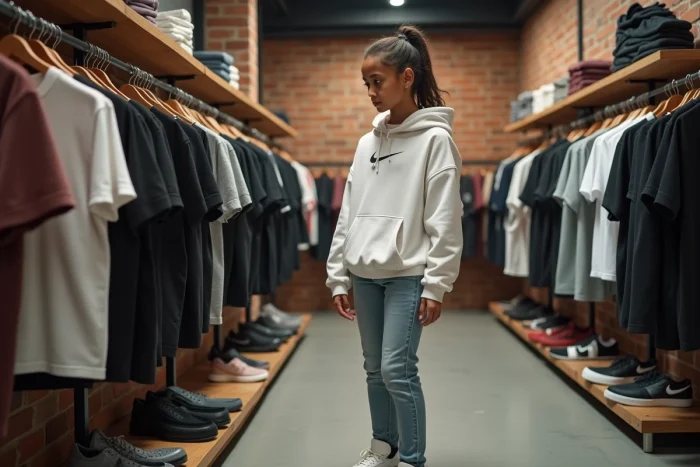
Nike remains the most spontaneously cited reference among teenagers across all social categories. The brand benefits from a double advantage: a high resale value on sought-after models and a sufficiently broad entry range to capture tight budgets. Adidas plays a similar role, with a slightly different positioning depending on regions and current trends.
Stüssy occupies a unique niche. The brand serves as a marker of fashion knowledge: wearing it signals that one follows streetwear trends beyond the mainstream. Its price, higher than Nike or Adidas for common pieces, makes it a purchase goal rather than a daily basic.
Fast fashion and luxury: the two extremes of the teen wardrobe
Between dominant sportswear and emerging micro-brands, two poles coexist. Fast fashion (Shein, Zara) remains massively used for filler pieces, those that aren’t showcased on social media. On the opposite end, second-hand luxury attracts teens who want a branded bag or accessory without the price of new. Resale platforms have made accessible a market that was once reserved for adults.
This cohabitation creates what could be called a layered wardrobe: anonymous basics, a core of high-identity sportswear pieces, and one or two “signal” items (limited sneakers, second-hand luxury accessories) that concentrate emotional and financial investment.
Teen brands and social media: the concrete role of the algorithm
We often talk about the influence of social media on the preferences of young consumers, but the precise mechanism deserves to be detailed. The TikTok algorithm does not show the same brands to a teen in Marseille as it does to a teen in Rennes. The content suggested depends on past interactions, the network of contacts, and location.
Two teens of the same age can have completely different brand universes simply because their news feeds diverge. This algorithmic compartmentalization partly explains why “favorite brand” rankings vary so much depending on sources and survey methods.
- A teen exposed to US streetwear content will mainly see brands like Supreme, Palace, or Corteiz in their feed
- A fashion-oriented profile will be more targeted by French DNVBs or eco-friendly brands
- A user interacting with “good deals” content will primarily receive fast fashion and promotion suggestions
The brands that perform well among teens right now are not necessarily those that spend the most on advertising. They are the ones whose organic content circulates, gets shared, and commented on. Brand preference among teenagers now functions like a flow: it moves at the pace of viral trends, filtered by the actual budget and social context of each young person.